
For many vehicle owners, the first sign of trouble is a small, dark puddle on the driveway. It starts as a nuisance—a minor stain on the concrete—but quickly evolves into a source of anxiety. Is the engine failing? How much will the repair cost? In many cases, the culprit isn't a cracked engine block or a catastrophic mechanical failure, but something far more subtle: the natural aging of the rubber components that keep your engine’s lifeblood contained.
As vehicles rack up miles, engines naturally experience significant wear and tear. To stay ahead of these inevitable issues, following a proactive automotive maintenance checklist is the first step toward long-term vehicle health and avoiding expensive repairs. While mechanical degradation of metal components is a well-known factor, the silent enemy of a high-mileage engine is the hardening and shrinking of rubber gaskets and seals. Fortunately, modern lubricant chemistry has evolved to meet this challenge head-on with a specialized group of additives known as Seal Swell Agents.
What Are Seal Swell Agents?
In the highly complex world of modern motor oil formulation, "oil" is no longer just refined crude. It is a precision-engineered fluid where base oils (mineral or synthetic) are blended with a sophisticated "additive package" that dictates how the fluid behaves under extreme stress.
Seal swell agents (often referred to as seal conditioners) are specific chemical additives designed to maintain the physical integrity and functional performance of elastomeric materials—the rubbers and plastics—found throughout the engine.
The Chemical Backbone
Technically, these additives are usually formulated using organic phosphates, esters, and aromatic hydrocarbons. They are chosen because their chemical structure is compatible with common automotive elastomers like Nitrile (NBR), Polyacrylate (ACM), and Silicone.
Rather than simply providing a temporary "coating" or a "stop-leak" film, these advanced compounds are designed for molecular interaction. They are "miscible" with the engine oil, meaning they travel wherever the oil goes, reaching deep into the crevices of the valve covers, oil pans, and main crankshaft seals.
Why Seals Fail: The Science of Hardening
To understand why we need seal swell agents, we must understand why engine seals fail in the first place. An internal combustion engine is a brutal environment. Seals are constantly subjected to:
Extreme Thermal Cycling: Engines go from ambient temperature to over 200°F (93°C) and back again thousands of times. This causes the rubber to expand and contract, leading to "heat set" where the rubber loses its memory and stays compressed.
Chemical Leaching: Over time, the plasticizers—the chemicals that make rubber soft and pliable—leach out of the gasket and into the engine oil.
Oxidation: Exposure to oxygen and blow-by gases causes the rubber to undergo a process called "cross-linking," which makes the material brittle, hard, and prone to cracking.
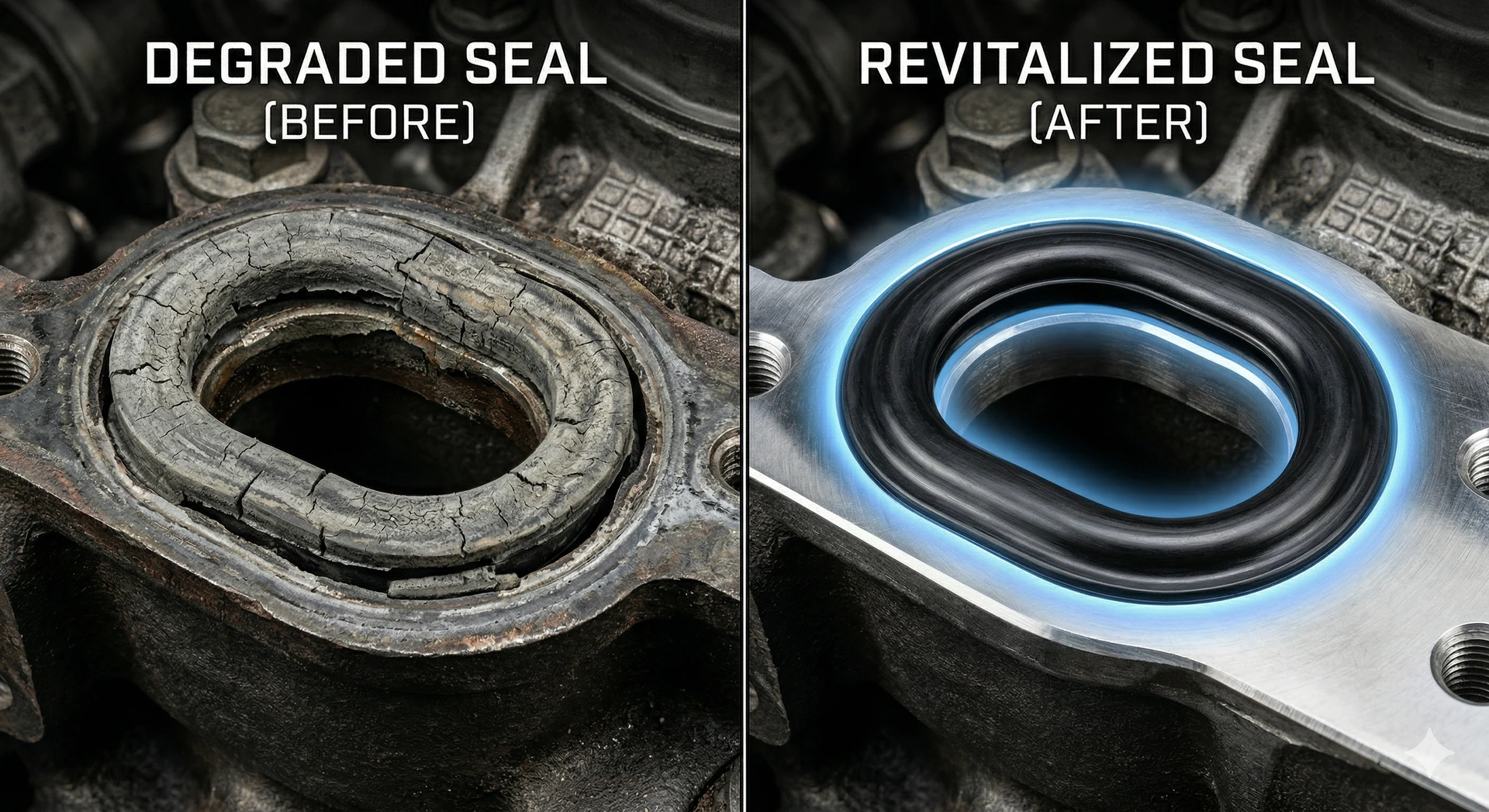
When a seal loses its elasticity, it can no longer "push back" against the metal surfaces it is supposed to seal. It shrinks, gaps form at a microscopic level, and the pressurized oil finds a way out.
How Seal Swell Agents Work: "Molecular Therapy"
When you introduce a motor oil containing seal swell agents into an aging engine, a process of diffusion begins. As the oil circulates, the seal conditioner molecules come into contact with the shrunken, hardened rubber.
Because these additives have a specific chemical affinity for elastomers, they physically soak into the rubber matrix. This process is often called "plasticizer replacement." The additives wedge themselves between the polymer chains of the rubber, forcing them to move apart slightly.
The result is a two-fold benefit:
Volume Increase (Swelling): The seal undergoes a controlled chemical reaction that causes it to swell slightly—typically between 2% and 5%. This is enough to close up micro-gaps and "re-seat" the seal against the metal.
Flexibility Restoration: By acting as a new plasticizer, the additive restores the "bounce" or elasticity to the rubber, allowing it to vibrate and move with the engine without cracking.
The High-Mileage Connection: Why 75,000 Miles Matters
The automotive industry generally considers 75,000 miles (approx. 120,000 km) the threshold where a vehicle enters its "high-mileage" phase. At this point, the seals have likely endured enough thermal cycles to begin the hardening process.
To combat this, lubricant manufacturers create "High-Mileage" motor oils. These are not just marketing gimmicks; they are chemically distinct from standard "Full Synthetic" or "Conventional" oils. A high-mileage formulation typically contains:
Elevated Concentrations of Seal Conditioners: While standard oils have some conditioners to keep new seals healthy, high-mileage oils have significantly higher doses to "revitalize" already-damaged seals.
Higher Viscosity Retention: High-mileage oils often sit at the higher end of their viscosity grade (e.g., a "thick" 5W-30) to help fill the larger internal clearances that occur as metal parts wear down.
Enhanced Anti-Wear Agents: Increased levels of Zinc (ZDDP) and Phosphorus are added to provide a sacrificial layer on metal surfaces like camshafts and lifters.
The Role of Valve Stem Seals
One of the most common issues in older cars is "burning oil," evidenced by a puff of blue smoke upon startup. This is frequently caused by hardened valve stem seals. When these seals shrink, oil seeps down the valve guide into the combustion chamber while the car is parked. By revitalizing these specific seals, seal swell agents can dramatically reduce oil consumption and keep your catalytic converter from clogging. Understanding exactly how your engine oil strategy saves your catalytic converter is vital, as oil-fouling is the leading cause of premature exhaust system failure
When Chemistry Isn't Enough: The Limits of Additives
While seal swell agents are incredibly effective, they are not magic. It is important for vehicle owners to manage expectations.
Preventative vs. Curative: Seal conditioners work best as a maintenance tool or for "weeping" leaks (dampness on the engine).
The "Point of No Return": If a gasket is physically torn, blown, or has a large chunk missing, no amount of chemical swelling will fix it. In these cases, a mechanical replacement is the only solution.
The Over-Swelling Risk: Lower-quality "stop-leak" products often use aggressive solvents that cause excessive swelling. This can make a seal so soft that it eventually disintegrates or "mushrooms" out of its seat, causing an even larger leak later on. Professional-grade high-mileage oils and reputable additives (like ABRO or specialized GE Trading partners) use controlled chemistry to ensure safety.
Summary of Seal Swell Agent Impact
| Feature | Mechanism | Primary Benefit |
| Controlled Swelling | Increases elastomer volume by 2-5% | Closes micro-gaps and stops active oil drips. |
| Elasticity Restoration | Replaces lost plasticizers in the rubber matrix | Prevents gaskets from cracking under vibration. |
| High-Mileage Synergy | Blended with extra anti-wear and detergents | Maximizes the lifespan of engines over 75k miles. |
| Internal Consumption | Treats valve stem seals and O-rings | Reduces blue smoke and oil burning in the chamber. |
| System Compatibility | Safe for Nitrile, Silicone, and Viton | Will not damage sensors or clog oil filters. |
Common Questions & Answers (Q&A)
Q: Can I use a high-mileage oil with seal swell agents in a new car?
A: Yes, it won't hurt a new engine, but it isn't necessary. New seals are already pliable. However, starting high-mileage oil around 60,000 miles can act as a great preventative measure to ensure seals never reach the "brittle" stage.
Q: How long does it take for seal swell agents to stop a leak?
A: This is not an instantaneous fix. Because the molecules must diffuse into the rubber, it typically takes 200 to 500 miles of driving (or a few weeks of regular use) to see a noticeable reduction in oil spots.
Q: Will these additives make my gaskets "mushy" or damage them?
A: When using reputable High-Mileage oils or certified additives like those found on the GE for Trading blog, the reaction is controlled. These formulas are tested to ensure they don't exceed a safe swelling limit. Problems only arise with "miracle" solvents that use harsh chemicals like acetone or high-concentration esters.
Q: Do synthetic oils cause leaks?
A: This is a common myth. In the early days of synthetics (the 1970s), some formulas caused seal shrinkage. Modern synthetics, however, are blended with seal conditioners specifically to prevent this. This is a perfect example of why debunking the illusion of identical motor oils is so important for owners of modern, high-performance engines who need precision protection. If a car starts leaking after switching to synthetic, it’s usually because the synthetic oil cleaned out old sludge that was "plugging" an existing hole.
Q: Is it better to use a "Stop Leak" additive or just switch to High-Mileage oil?
A: For general maintenance and minor dampness, switching to a High-Mileage oil is the smartest, most balanced approach. If you have an active drip that you need to slow down immediately before a major repair, a concentrated additive like ABRO Super Seal might be a more potent short-term solution.
Learn More About Protecting Your Engine
Maintaining an aging vehicle requires a proactive approach to lubrication and additive chemistry. Understanding the "invisible" parts of your engine—like the gaskets and seals—is the key to avoiding high repair bills and keeping your car on the road for years to come.
To dive deeper into how you can extend the life of your vehicle and stop frustrating leaks, check out these comprehensive resources on the GE for Trading blog:
This article is part of our Engine Oil Master Guide—your definitive resource for engine protection.