
It is a scenario that plays out in automotive workshops and auto parts stores across Egypt every single day. A customer walks in, looks at the shelf, and sees five different bottles of 5W-30 motor oil. They all display the exact same American Petroleum Institute (API) "Donut" stating they meet the latest API SP standards. However, many drivers are unaware of the technical requirements involved in decoding the 2025 API engine oil shift and how it affects engine longevity. They all have the exact same Society of Automotive Engineers (SAE) viscosity rating.
Yet, the prices vary wildly. One bottle costs 500 EGP, another 900 EGP, and a .premium imported brand demands 1,500 EGP. In our recent testing, we saw how the big three brands, Valvoline, Liqui Moly, and Castrol compared in these high-stakes scenarios.
It is incredibly common to hear someone say, “Motor oil is motor oil, they are all the same”. To understand why this is a myth, you must consider the evolution of API SN vs. API SP vs. API SQ standards, which reveal the real level of protection your engine is receiving. Does a higher price tag actually guarantee better engine protection and a longer engine lifetime, or is it just clever marketing?
The truth is that API and SAE specifications are merely the starting line. Two oils with identical ratings on the bottle can have vastly different chemical makeups, varying levels of thermal stability, and dramatically different impacts on the lifespan of your engine. Here is the science behind why all motor oils are not created equal, and how to navigate the hype in the Egyptian lubricants market.
SAE and API: Minimum Requirements, Not Maximum Capabilities
To understand the difference in quality, we must first understand what the labels actually mean.
SAE Viscosity: The SAE rating (like 5W-30 or 10W-40) simply defines the oil’s physical thickness and its resistance to flow at specific temperatures. The "W" stands for Winter, indicating how well the oil flows during a cold engine startup, while the second number dictates the oil's thickness at an operating temperature of 100°C. If two oils are 5W-30, it just means they both flow at a similar rate at those two specific temperature points. It tells you nothing about the oil's quality, purity, or how long it will last.
API Standards: The American Petroleum Institute (API) categorizes oils based on laboratory and engine tests to measure things like wear protection, sludge control, and oxidation. If an oil displays the latest API SP mark, it means it passed the minimum required thresholds for modern gasoline engines.
However, think of an API standard like a university passing grade. A student who scores 50% passes the class, and a student who scores 99% also passes the class. Both receive the exact same diploma. Similarly, a budget motor oil might barely scrape by the API SP testing requirements, while a premium formulation might exceed those minimum wear-protection standards by 300%. Both get to print "API SP" on the bottle.
The Foundation of Quality: Base Oil Groups
The most significant difference between brands lies in the base oil. Every bottle of motor oil is a recipe: typically 70% to 90% base oil, mixed with 10% to 30% chemical additives.
The API divides base oils into five distinct groups based on how they are refined. This is where the performance gap between brands begins to widen:
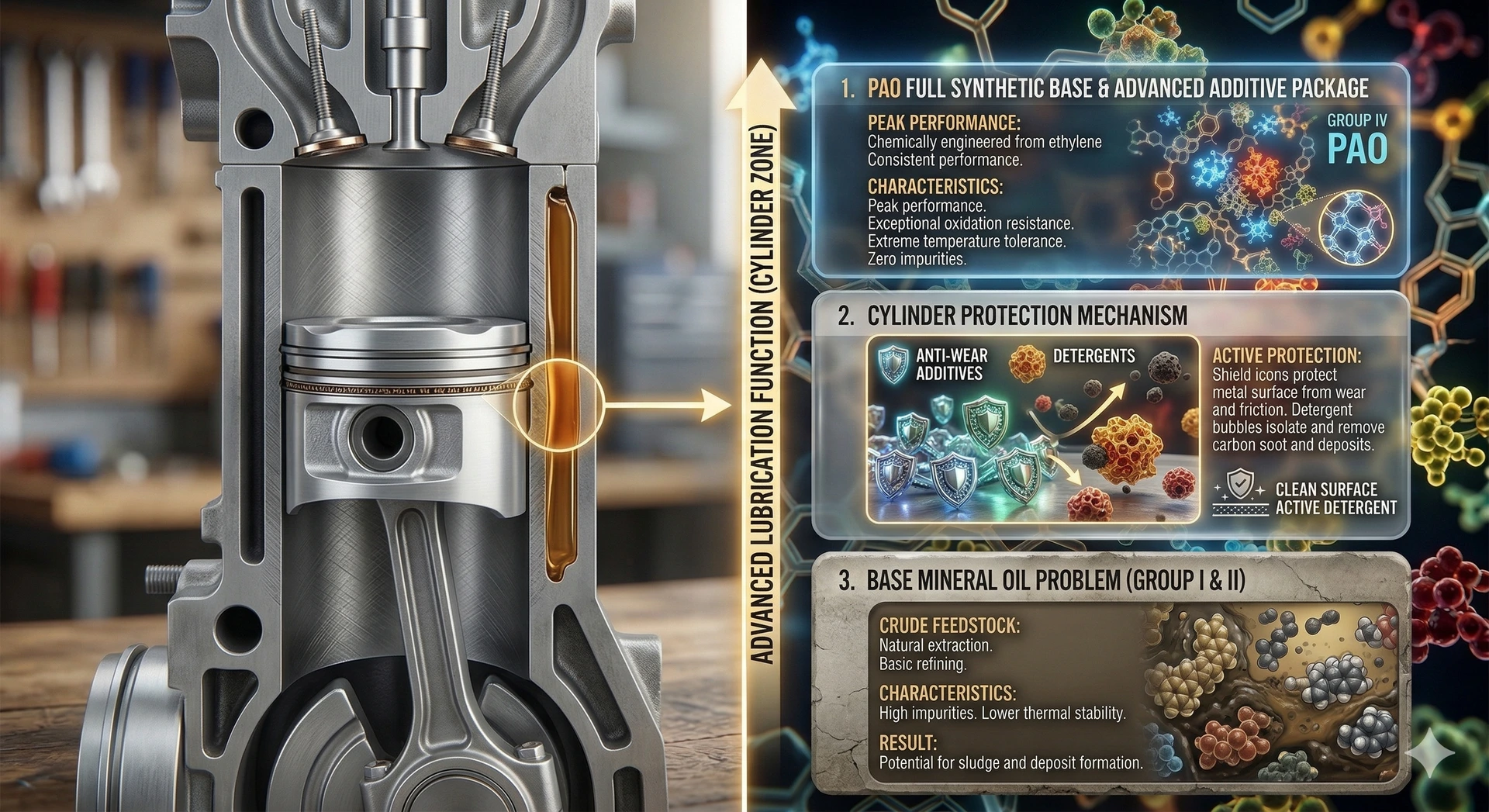
Group I and II (Conventional/Mineral Oils): These are derived directly from crude oil through solvent refining or basic hydrocracking. They contain impurities, irregular molecular shapes, and varying sulfur levels. They are cheap to produce, but they break down and evaporate quickly under high heat.
Group III (Synthetic Technology): These are highly refined, severely hydrocracked mineral oils. Because they are purified to a high degree, they legally qualify to be marketed as "Synthetic" or "Full Synthetic" in most of the world. They offer excellent thermal resistance and are the most common base for modern motor oils.
Group IV (Polyalphaolefins - PAO): This is a true synthetic. PAOs are not pumped out of the ground; they are chemically engineered in a laboratory from the ground up. Their molecular structure is perfectly uniform. Group IV oils can withstand extreme heat and brutal cold without breaking down, offering the ultimate engine protection.
Group V (Esters/PAGs): These are highly specialized synthetic base stocks often used in racing and aviation to provide exceptional extreme-pressure protection and polarity (the ability of the oil to cling to metal parts like a magnet).

If you buy a cheap 5W-30 API SP oil, the manufacturer likely used a basic Group II or Group III base oil blend. If you buy a premium 5W-30 API SP oil, the blender may have utilized expensive Group IV PAO base stocks. The PAO oil will resist shearing, prevent sludge buildup, and maintain its protective film under high RPMs much longer than the budget oil, vastly extending your engine's lifetime.
The Secret Weapon: The Additive Package
If the base oil is the foundation, the additive package is the armor. Oil manufacturers purchase chemical additive packages to mix into their base oils. These additives include:
Detergents and Dispersants: To neutralize corrosive combustion acids and keep soot suspended so it doesn't form sludge.
Anti-Wear Agents: Chemicals like ZDDP (Zinc Dialkyldithiophosphate) that create a sacrificial chemical film over metal parts to prevent friction wear.
Friction Modifiers: Elements like Molybdenum that reduce internal drag and boost fuel economy.
Viscosity Index (VI) Improvers: Polymers that expand and contract with heat to keep the oil stable.
Here is why brands differ: Premium additives are wildly expensive. A highly-rated, expensive oil brand will use highly shear-stable "starburst" polymer VI improvers that do not break down over a 10,000 km drain interval. A budget brand will use cheaper "linear" polymers that physically shear and break apart inside the engine. Once the cheap polymers break, the budget 5W-30 oil might thin out to a 5W-20 oil while you are driving, resulting in a loss of oil pressure and catastrophic metal-on-metal wear.
The Egyptian Market: Navigating the Hype and Overrated Brands
The Egyptian automotive market presents a unique and grueling environment for motor oil. Our vehicles are subjected to intense summer heat, heavy stop-and-go traffic in cities like Cairo and Alexandria, and high levels of atmospheric dust. This constitutes "severe service" driving, which accelerates oil oxidation, thermal breakdown, and acid formation.

Because of these conditions, Egyptian consumers are often extremely loyal to specific "big name" multinational brands, believing that a recognizable logo guarantees the best protection. Unfortunately, in the lubricant industry, marketing often outpaces engineering. As one industry veteran aptly put it: "The oil industry and the wine industry are very similar—BOTH their labels are written by POETS".
How Brands Become Overrated Many highly sought-after, expensive brands in the Egyptian market are genuinely overrated. Here is why:
The "Synthetic" Loophole: Many famous imported brands charge premium prices for oil labeled "Full Synthetic," when in reality, they are using affordable Group III hydrocracked mineral oils. While Group III is good, you are often paying Group IV (PAO) prices for Group III performance simply because of the brand's massive marketing budget and motorsport sponsorships.
The Thickness Myth: In Egypt, there is a persistent, outdated mechanic's myth that thicker oil is always better for our hot climate. Many highly overrated brands push expensive, thick 20W-50 conventional oils to consumers. However, pouring thick conventional oil into a modern, tight-clearance engine actually increases internal engine temperatures due to fluid friction, and conventional oils break down faster under heat than thinner synthetics.
Local vs. Imported: Some local Egyptian blenders or mid-tier imported brands offer exceptional value. They purchase the exact same high-quality additive packages from global chemical giants (like Lubrizol or Infineum) and blend them with robust Group III base oils. These lesser-known oils often provide the exact same—or superior—engine protection as the highly marketed, overrated global brands, but at half the price.
Conclusion: How to Maximize Engine Lifetime
To answer the ultimate question: No, all oils with the same viscosity and API standard are not the same. They differ fundamentally in their base oil purity, the strength of their anti-wear additives, and their ability to resist thermal breakdown.
Using a budget oil that merely meets the API standard is perfectly safe if you change your oil very frequently. However, if you want to push your drain intervals to 10,000 km, or if you drive a modern turbocharged engine that runs extremely hot, investing in a high-quality, genuine synthetic oil with a robust additive package is the only way to guarantee maximum engine lifetime.
Do not fall for labels written by marketing "poets." Look beyond the brand name. Understand the base oil group, verify the API and ACEA approvals, and always follow your vehicle manufacturer's OEM specifications.
Ready to give your engine the exact chemical protection it needs? Visit the GE for Trading digital storefront to explore our curated selection of premium, verified motor oils and Get the complete Engine Oil Master Guide in Egypt today!