
he automotive lubrication industry is currently undergoing one of its most significant shifts in half a decade. This shift is part of the great lubricant illusion, where modern standards are required to protect advanced engine components that older oils simply cannot handle. On shop shelves and in dealership service bays, the familiar API SP and ILSAC GF-6 standards are gradually being phased out, making way for the highly anticipated API SQ standard.
To the average driver, this alphabet soup of acronyms can be overwhelming. Do you need ILSAC? Do you need API? And is the jump to the new SQ standard really worth it?
In this comprehensive guide, we will compare ILSAC GF-6, API SP, and the newly minted API SQ to help you understand exactly what is happening inside your engine's crankcase, and why choosing the right oil has never been more critical.
Visit Our Profi-car Engine Oil Collection in Egypt.
The Twin Standards: How API and ILSAC Work Together
Before comparing the individual grades, it is vital to understand that API (American Petroleum Institute) and ILSAC (International Lubricant Standardization and Approval Committee) are not competing standards; they are complementary.
API Standards (e.g., SP, SQ): These set the global baseline for engine protection. They dictate how well an oil fights sludge, prevents metal-on-metal wear, cleans internal components, and resists breaking down under extreme heat.
ILSAC Standards (e.g., GF-6, GF-7): ILSAC takes the API standard and adds grueling tests specifically focused on fuel economy and emissions system protection.
Therefore, when a new standard generation is born, they usually launch as a pair. API SP launched alongside ILSAC GF-6 in 2020. Now, API SQ is launching alongside ILSAC GF-7 in 2025. While they are technically separate, an oil that meets ILSAC GF-7 almost universally meets API SQ.
API SP & ILSAC GF-6: The LSPI Fighters (2020)
Introduced in May 2020, API SP and GF-6 were emergency responses to the massive rise of Turbocharged Gasoline Direct Injection (TGDI) engines.
These smaller, highly pressurized engines were suffering from a catastrophic phenomenon called Low-Speed Pre-Ignition (LSPI)—a premature explosion in the cylinder that occurred before the spark plug even fired. This rogue detonation could bend connecting rods, destroy spark plugs, and crack pistons in half. Older oils (like API SN) actually exacerbated this issue due to their calcium-heavy detergent packages.
Key Features of SP / GF-6:
Fresh Oil LSPI Mitigation: They introduced new chemical formulations (swapping calcium for magnesium) to suppress LSPI events when the oil was fresh.
Timing Chain Protection: Direct-injection engines produce high levels of soot, which can act like abrasive sandpaper on timing chains. API SP introduced the Sequence X test, specifically formulated to prevent this chain wear.
Viscosity Split: GF-6 was split into GF-6A (standard viscosities like 5W-30) and GF-6B (specifically for ultra-thin 0W-16 oil).
API SQ: The Next-Gen Guardian (2025)
As hybrid powertrains became the norm and global emissions regulations tightened significantly, engines began running hotter and tolerating far less internal friction. API SP was excellent for its time, but it had a vulnerability: its LSPI protection weakened as the oil aged and broke down.
Enter API SQ (launched alongside ILSAC GF-7 in March 2025). It takes the solid foundation of SP and drastically tightens the performance limits, introducing groundbreaking new protections for the most modern, highly stressed vehicles.
The Big Comparison: API SP vs. API SQ
Here is exactly where the new API SQ standard outperforms the outgoing API SP/GF-6 generation:
1. Aged-Oil LSPI Protection (The Biggest Upgrade)
API SP: Provided excellent LSPI protection when the oil was freshly poured into the engine. However, as the oil oxidized, absorbed fuel blow-by, and degraded over thousands of miles, that protection faded, leaving engines vulnerable right before their next oil change.
API SQ: Introduces a rigorous new testing standard (Sequence IX) that guarantees the oil will suppress LSPI events throughout the entire oil drain interval. Even at 5,000 or 7,500 miles, API SQ is actively defending your pistons from premature detonation.
2. Timing Chain Wear Limits
API SP: API SP: Introduced a timing chain wear limit of 0.085 mm. To see how this standard compares to older and newer grades, consult our complete guide to engine oil standards for a full breakdown of protection levels..
API SQ: Tightens the allowable wear limit down to 0.080 mm. This reduction in allowable wear means your timing chain will stay tighter, quieter, and more reliable over the 150,000+ mile life of the vehicle.
3. GPF and Emissions Defense
API SP: Had standard ash limits that were acceptable for older catalytic converters.
API SQ: Strictly limits "sulfated ash" to a maximum of 0.9%. This is crucial for modern cars equipped with Gasoline Particulate Filters (GPFs) in the exhaust. High ash content permanently clogs these filters, leading to thousands of dollars in exhaust repairs. API SQ prevents this costly buildup.
4. Ultra-Low Viscosities for Hybrids
API SP / GF-6: Accommodated oils down to SAE 0W-16.
API SQ / GF-7: Specifically engineered to support the mass rollout of ultra-thin, hyper-efficient oils like SAE 0W-8 and SAE 0W-12. These grades are essential for maximizing the fuel economy of the latest hybrid models that rapidly cycle their engines on and off.
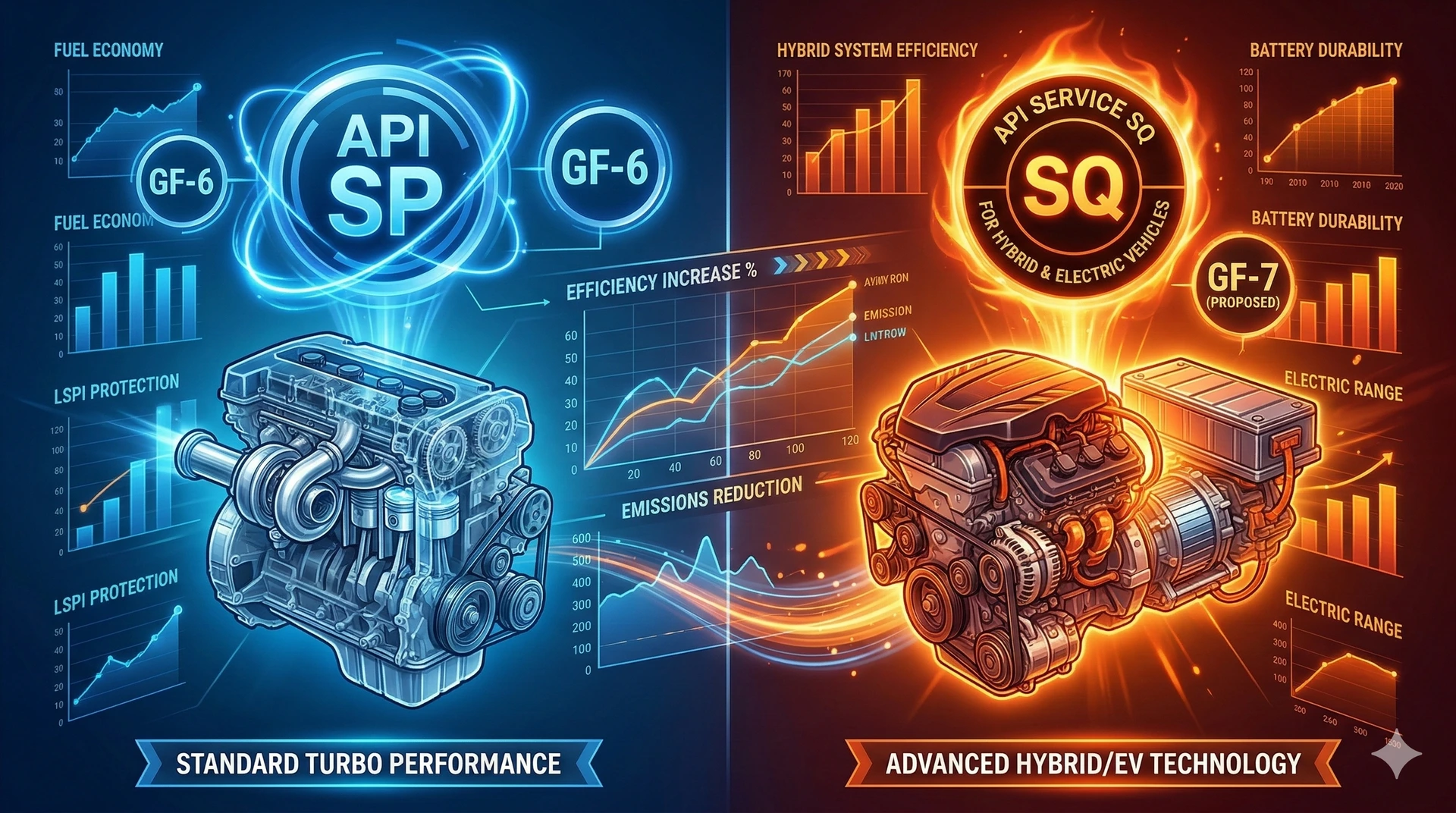
Summary Table: API SP / GF-6 vs. API SQ / GF-7
Use this side-by-side comparison to quickly understand the generational leap between the 2020 and 2025 engine oil standards.
| Feature / Metric | API SP & ILSAC GF-6 (2020) | API SQ & ILSAC GF-7 (2025) |
| Primary Engine Focus | TGDI (Turbo Direct Injection) | TGDI & Modern Hybrid Powertrains |
| LSPI Protection Focus | Fresh Oil Defense Only | Fresh & Aged Oil Defense |
| Timing Chain Wear Limit | 0.085 mm | 0.080 mm (Stricter limits) |
| Emissions / GPF Defense | Standard Catalytic Protection | Strict Max 0.9% Sulfated Ash Limit |
| Viscosity Support | Grades down to SAE 0W-16 | Grades down to SAE 0W-8 & 0W-12 |
| Fuel Economy Gains | Baseline standard | Up to 0.5% improvement over SP |
| Backward Compatible? | Yes (Replaces API SN) | Yes (Replaces API SP & SN) |
Frequently Asked Questions (Q&A)
Q: Should I wait to change my oil until API SQ is available, or is API SP still safe to use?
A: API SP is still a highly capable and safe engine oil. However, as API SQ rolls out in 2025, it will naturally replace API SP on the shelves. You do not need to wait, but the next time you are due for a service, upgrading to API SQ will provide your engine with enhanced, longer-lasting protection.
Q: If my car's manual specifically calls for ILSAC GF-6, will using API SQ / GF-7 void my warranty?
A: No, it will not void your warranty. The API and ILSAC systems are designed to be backward compatible. API SQ and ILSAC GF-7 exceed all the performance requirements of GF-6 and API SP. Using a newer, higher-rated specification is fully approved by automakers and is the best way to extend the life of your engine.
Q: What exactly is "Aged-Oil LSPI" and why is it so dangerous?
A: Low-Speed Pre-Ignition (LSPI) is a premature explosion in the engine cylinder. While older oils (like API SP) protected against this when the oil was new, engineers discovered that as oil breaks down and mixes with unburnt fuel over time ("aged oil"), the risk of LSPI returns. API SQ is specifically formulated with advanced detergents to neutralize this threat even when the oil is dirty and due for a change.
Q: Do I need the new 0W-8 viscosity if I upgrade to API SQ?
A: No. API SQ and ILSAC GF-7 apply to all standard viscosities, including 5W-30, 0W-20, and 5W-20. You should always use the specific viscosity printed on your oil cap or in your owner's manual. The API SQ standard simply means that whatever viscosity you choose, it meets the highest tier of global protection.
Q: Can I mix API SP and API SQ oils if I am just topping off my engine?
A: Yes. Since API SQ is backward compatible with API SP, they share compatible base oils and additive families. Mixing them will not harm your engine. However, diluting the new API SQ oil with the older SP formula means you will not get the full benefits of the aged-oil LSPI protection or the enhanced fuel economy. For maximum protection, a complete oil change is always recommended.
This article is part of our Engine Oil Master Guide in Egypt—your definitive resource for engine protection. For a solid foundation in these terms, we recommend starting with our introduction to ILSAC oil specifications."