
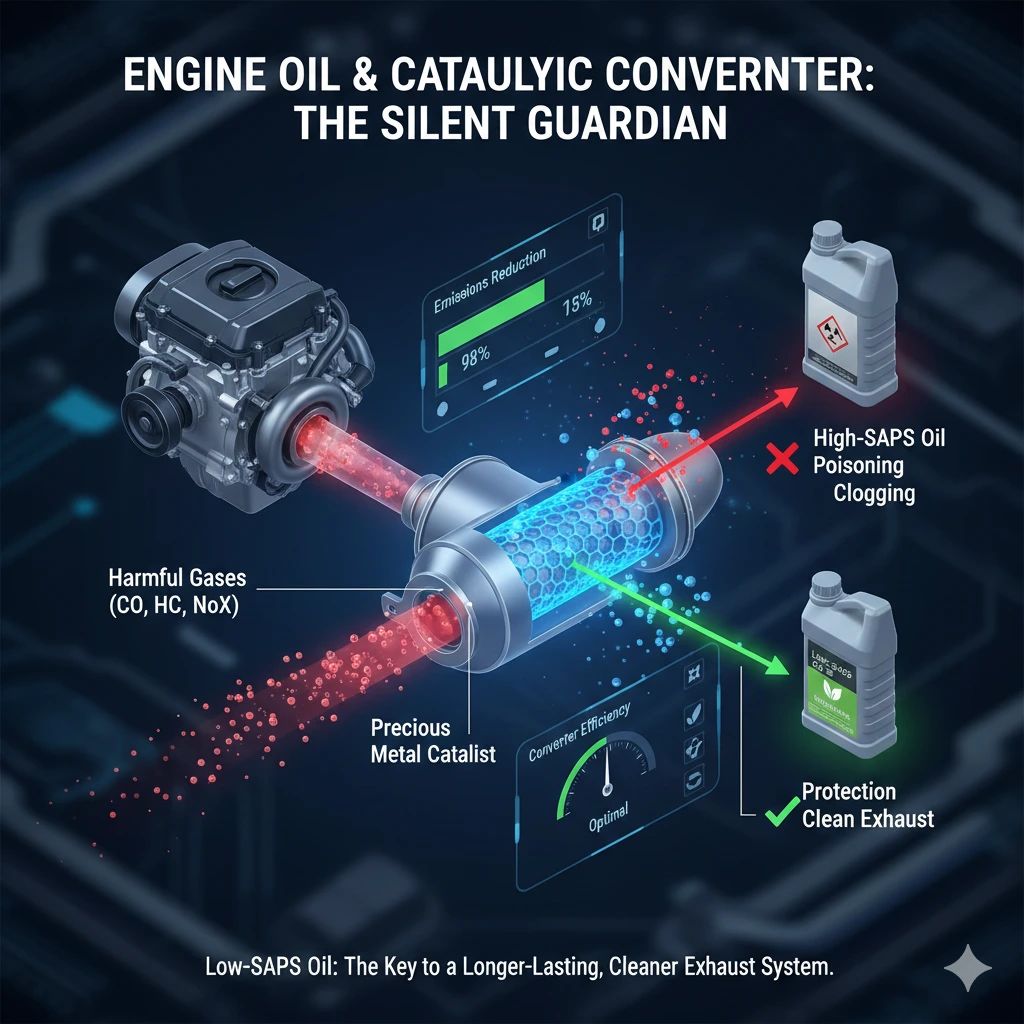
To keep your vehicle running cleanly and efficiently, you must understand that your engine oil and catalytic converter are not independent parts—they are partners in a delicate chemical dance. The "main idea" is simple: using the wrong oil can permanently "poison" your expensive catalytic converter, while the right oil strategy acts as a shield, extending the life of your exhaust system and ensuring you pass every emissions test.
Top 10 Relations: Converter Types & Engine Oil Strategies
In the high-stakes world of automotive maintenance, this relationship is often the "silent killer" of vehicle longevity. While most drivers focus on fuel quality, the specific chemistry of your engine oil determines whether your exhaust system lasts 200,000 km or fails at 60,000 km.
1. The Chemical "Poisoning" Effect
The most direct relation is chemical poisoning. When oil is consumed during normal operation, additives like phosphorus and zinc are sent into the exhaust. These create a permanent "glassy" coating over the precious metals (platinum, palladium, rhodium) inside the converter, preventing them from neutralizing harmful gases.
2. SAPS Content and Converter Life
Modern oil strategies revolve around SAPS (Sulfated Ash, Phosphorus, and Sulfur).
Low-SAPS Oils: Specifically developed to protect modern converters and Diesel Particulate Filters (DPF).
High-SAPS Oils: Standard in older engines, these can clog the fine ceramic honeycomb structure of modern exhaust systems.
3. Three-Way Catalysts (TWC) vs. Phosphorus
Found in most modern petrol cars, Three-Way Catalysts are highly sensitive to phosphorus. It forms an overlayer that increases the "light-off" temperature—the heat needed for the converter to start working—meaning your car stays in a high-pollution state longer after startup.
4. Two-Way Catalysts and Traditional Oils
Older vehicles with Two-Way Catalysts (converting CO and Hydrocarbons) are more tolerant of traditional oils. However, switching them to modern Low-SAPS oil can sometimes lead to increased mechanical wear, as these engines often require the higher anti-wear levels (ZDDP) found in older oil designs.
5. Diesel Oxidation Catalysts (DOC) and Ash
In diesel engines, the DOC works with the DPF. The strategy here must prioritize "low-ash" formulations. High-ash oil creates a physical residue that cannot be burned off, leading to permanent blockage.
6. ZDDP: The Anti-Wear Trade-off
ZDDP is a legendary anti-wear agent but is the primary source of phosphorus and sulfur. Modern strategies reduce ZDDP to protect the converter, substituting it with ashless agents like boron or molybdenum to keep the engine safe.
7. Turbocharger Seals and Oil Seepage
Worn turbo seals can leak oil directly into the hot exhaust stream. In these cases, using Full Synthetic oil with high thermal stability is critical to prevent "oil burning" that kills the converter instantly.
8. Viscosity and Cold Start Emissions
Converters only work when hot. Using low-viscosity oils (e.g., 0W-20) allows for faster engine warm-up. This reduces the "cold start" period where raw fuel and oil vapors are most likely to hit the catalyst.
9. Piston Ring "Blow-by"
As engines age, blow-by increases, pushing more oil into the combustion chamber. For high-mileage cars, the strategy shifts to oils with seal conditioners to reduce oil consumption and protect the converter's remaining life.
10. The ACEA "C" Classifications
The European Automobile Manufacturers' Association (ACEA) created the "C" grade classifications specifically for this relationship.
C1/C4: Essential for sensitive DPF/SCR systems (ultra-low SAPS).
C2/C3: Balanced mid-SAPS for modern high-performance engines.
Frequently Asked Questions (Q&A)
Q: Can I use standard oil if my car has a catalytic converter?
A: Most modern cars require specific "Catalyst Compatible" oils (like ACEA C-series). Using standard high-SAPS oil will significantly shorten the life of your converter.
Q: What are the signs of catalytic converter damage from oil?
A: Common signs include a "Check Engine" light (P0420 code), reduced fuel economy, a sulfur smell, and failed emissions tests.
Q: Is "Low-SAPS" oil worse for my engine's metal parts?
A: While it has fewer traditional metallic anti-wear agents, modern Low-SAPS oils use advanced chemical substitutes to provide equal protection without harming the exhaust.
Summary Table: Converter Type vs. Oil Strategy
| Converter Type | Vehicle Type | Recommended Oil Strategy | Primary Risk of Wrong Oil |
| Two-Way Catalyst | Older Petrol | High Anti-Wear (ZDDP) | Accelerated engine wear |
| Three-Way Catalyst | Modern Petrol | Low/Mid-SAPS (ACEA C2/C3) | Catalyst "Poisoning" |
| DOC + DPF | Modern Diesel | Ultra-Low Ash (ACEA C4) | Permanent filter clogging |
| SCR System | Heavy Duty/Diesel | Sulfur-Sensitive | Urea system contamination |