
If you have ever picked up a bottle of modern motor oil, you have likely seen a circular, toothed logo on the front label—often referred to as the "Starburst." This little symbol carries immense weight in the automotive world, signifying that the oil inside meets the strict, fuel-efficiency-focused standards of ILSAC.
But what exactly is ILSAC, and why does it have its own set of rules separate from the baseline criteria outlined in our simple guide to API standards?
In this introductory guide, we are breaking down the history, purpose, and mechanical importance of ILSAC specifications, and why understanding them is critical to protecting your modern engine and maximizing your gas mileage.
What is ILSAC?
ILSAC stands for the International Lubricant Standardization and Approval Committee.
Formed in 1992, ILSAC is a collaborative joint committee created by the American Automobile Manufacturers Association (AAMA) and the Japan Automobile Manufacturers Association (JAMA). Essentially, it represents the combined engineering demands of major U.S. and Japanese automakers—think Ford, General Motors, Chrysler, Toyota, Honda, and Nissan.
While the American Petroleum Institute (API) creates the baseline performance standards for engine oils (protecting against wear, sludge, and oxidation), automakers realized they needed a standard that went a step further. They needed motor oil that didn't just protect the engine, but actively helped it burn less fuel and emit fewer greenhouse gases.
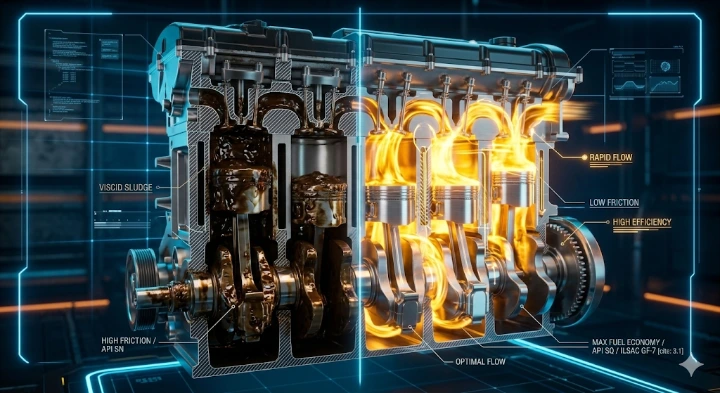
Thus, ILSAC was born to push boundaries, showing exactly how resource conserving oils boost fuel economy while simultaneously shielding internal engine components from frictional drag.
The "GF" Rating System Explained
ILSAC uses a "GF" (Gasoline Fueled) naming convention, followed by a number indicating the generation of the standard.
GF-1 (1996): The inaugural standard, establishing baseline fuel economy requirements.
GF-5 (2010): A major leap forward that introduced strict limits on phosphorus to protect catalytic converters and improved deposit control for turbochargers.
GF-6 (2020): Divided into GF-6A and GF-6B, this generation revolutionized oil by actively fighting Low-Speed Pre-Ignition (LSPI) in modern engines, establishing the technical foundation for our ultimate low-viscosity guide covering the generational jump to modern criteria.
GF-7 (2025): The newest frontier, focusing on ultra-low viscosities and aged-oil LSPI protection, which serves as a major pillar in the 2026 guide to engine oil standards.
Every time engine technology advances—such as the shift to gasoline direct injection (GDI) or the rise of hybrid powertrains—ILSAC releases a new GF standard to ensure the oil can handle the new thermal stresses and friction requirements.
ILSAC vs. API: What is the Difference?
It is easy to confuse ILSAC and API because they are deeply intertwined. When a new standard is developed, they are usually launched simultaneously (e.g., API SP launched alongside ILSAC GF-6).
However, they have distinct focuses:
API (The Shield/Donut): Focuses on overall engine protection, wear defense, and sludge prevention for a massive variety of engines. It uses an "S" prefix (e.g., API SN, API SP).
ILSAC (The Starburst): Takes the API standard and adds strict fuel economy and emissions system compatibility tests.
If an oil meets API SP but does not pass the rigorous fuel economy retention tests, it cannot carry the ILSAC GF-6 Starburst. Therefore, ILSAC oils are considered a specialized, efficiency-driven subset of API oils, which we unpack completely in our deep dive into resource conserving oil specifications.
(Note: ILSAC standards only apply to lighter viscosity grades like 0W-16, 0W-20, 5W-20, 5W-30, and 10W-30. Heavier oils like 15W-40 or 20W-50 cannot achieve the fuel efficiency required to earn an ILSAC badge).
Why ILSAC Matters for Your Engine
Modern engines are built with incredibly tight tolerances. To meet global emissions mandates, automakers are using thinner oils that flow faster, reducing internal drag on the engine's moving parts.
Using an ILSAC-approved oil guarantees three critical things:
Fuel Efficiency: The oil contains advanced friction modifiers that allow the engine components to slide past each other with minimal resistance, saving you money at the pump.
Catalytic Converter Life: ILSAC limits chemical compounds like phosphorus and sulfur to emphasize low-saps technology as the primary defense against poisoning your vehicle's exhaust aftertreatment systems.
Turbocharger Defense: ILSAC oils are heavily tested for volatility (burn-off) and deposit control, ensuring that the intense heat of a turbocharger won't bake the oil into destructive sludge.
When you see the ILSAC Starburst on a bottle of oil, you are not just buying lubrication; you are buying a highly engineered fluid designed to keep your car compliant, efficient, and protected.
The Evolution of Modern Engine Oil Standards
This table provides a quick, scannable reference guide for your readers to understand how the newest standards stack up against the previous generation.
| Feature / Specification | ILSAC GF-6 (A & B) / API SP | ILSAC GF-7 (A & B) / API SQ |
| Release Date | May 2020 | March 2025 |
| Primary Engine Focus | TGDI (Turbo Direct Injection) | TGDI & Modern Hybrid Powertrains |
| LSPI Protection | High (Protects when oil is fresh) | Maximum (Protects with fresh and aged oil) |
| Timing Chain Wear Limit | 0.085 mm | 0.080 mm (Stricter limits for longer life) |
| Emissions / GPF Defense | Standard Ash Limits | Strict Max 0.9% Sulfated Ash |
| Viscosity Focus | Standard grades down to SAE 0W-16 | Includes ultra-low SAE 0W-8 and 0W-12 |
| Backward Compatibility | Yes (except GF-6B 0W-16) | Yes (except GF-7B 0W-16) |
Frequently Asked Questions (Q&A)
Adding an FAQ section is excellent for capturing Google "People Also Ask" search snippets. Here are the most valuable questions to include:
Q: Can I use the new ILSAC GF-7 or API SQ oil in my older vehicle?
A: Yes! Both API SQ and ILSAC GF-7A are fully backward compatible with older engines that originally called for API SP, SN, or older ILSAC standards like GF-6A or GF-5. Upgrading to the newest standard will simply provide your older engine with superior wear protection, better sludge control, and improved fuel economy.
Q: What is the difference between an "A" standard (like GF-6A) and a "B" standard (like GF-6B)?
A: The "A" standards (GF-6A, GF-7A) cover traditional oil viscosities like 0W-20, 5W-20, and 5W-30, and are backward compatible with older cars. The "B" standards (GF-6B, GF-7B) are formulated exclusively for ultra-thin oils like SAE 0W-16. You should never use a "B" standard oil unless your owner's manual explicitly requires that specific ultra-low viscosity.
Q: Why was API SQ / GF-7 created so soon after API SP / GF-6?
A: As emissions regulations tighten globally, automakers are relying heavily on hybrid powertrains and even smaller, hotter turbocharged engines. These engines demand ultra-thin oils (like 0W-8) to maximize fuel efficiency, and they require a new level of defense against "aged-oil LSPI"—meaning the oil must prevent catastrophic engine knocking even right before it is due for an oil change.
Q: If my manual specifically asks for API SN, will API SP or SQ harm my engine?
A: Not at all. In the API rating system, newer letters supersede the older ones. API SP and API SQ contain all the protections of API SN, plus significant modern chemical upgrades. Using a newer specification is highly recommended to extend the life of your engine.
Q: Does using an ILSAC-certified oil actually save me money on gas?
A: Yes. ILSAC standards mandate strict fuel economy retention tests. These oils contain advanced friction modifiers that allow your engine's internal components to move with less resistance compared to standard, non-ILSAC oils. Over the lifespan of your vehicle, this reduction in mechanical drag translates directly to measurable fuel savings, showing why our introduction to resource conserving engine oils is an essential read for cost-conscious drivers.
This article is part of our Engine Oil Master Guide in Egypt—your definitive resource for engine protection and fuel efficiency.