
The Ultimate Guide to Engine Coolant: Colors, Chemistry, and Care
You are standing in an auto parts store in Cairo, faced with a wall of colorful bottles: green, blue, red, orange, and yellow. Every car owner knows coolant is essential for surviving the scorching Egyptian summer and preventing internal corrosion. However, choosing the wrong one can lead to "sludge" formation, overheating, and catastrophic engine failure.
This guide demystifies the "coolant code," moving beyond simple colors to explore the chemistry and maintenance required to keep your vehicle healthy on Egyptian roads.
I. Why Coolant Matters: More Than Just "Anti-Freeze"
Coolant is the lifeblood of your engine’s thermal management system. It performs three critical functions:
Temperature Regulation: While pure water boils at 100°C, engine operating temperatures often exceed this. Coolant contains glycol, which raises the boiling point to prevent vaporization and lowers the freezing point to prevent the engine block from cracking in winter.
Corrosion Protection: Modern engines use a mix of aluminum, steel, copper, and brass. Coolant contains additives that form a microscopic protective barrier on these metals, preventing rust and scale buildup.
Lubrication: Coolant lubricates the water pump’s internal seals and bearings, preventing premature wear.
II. Coolant Chemistry: The "Secret Sauce"
Every bottle of coolant is a precise mixture of three components:
Purified Water: You should never use tap water. It contains minerals that cause "scaling" (calcification) inside your radiator. Only distilled or deionized water should be used.
Glycol: Usually Ethylene Glycol (high efficiency) or Propylene Glycol (less toxic). This provides the freeze/boil protection.
Additives: This is what differentiates types. Additives include corrosion inhibitors, anti-foaming agents, and buffers to maintain pH balance.
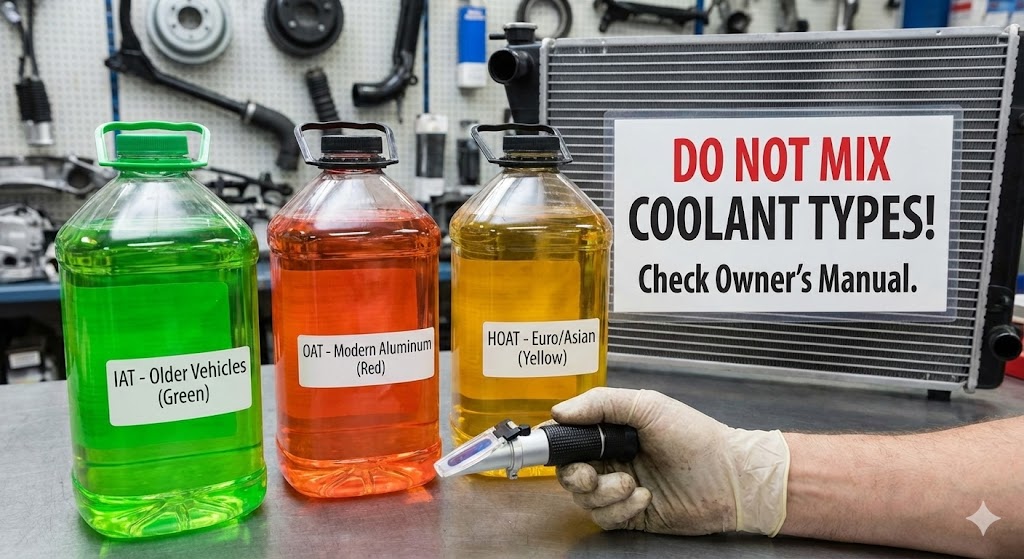
III. Understanding Coolant Technologies (IAT, OAT, HOAT)
The automotive industry has evolved through three main chemical stages. Matching the right technology to your engine is more important than matching the color.
Technology | Common Colors | Key Chemical Additives | Typical Service Life |
IAT (Inorganic Additive Tech) | Bright Green | Silicates & Phosphates | 2 Years / 50,000 km |
OAT (Organic Acid Tech) | Red, Orange, Pink | Carboxylates (Silicate & Phosphate Free) | 5 Years / 150,000 km |
HOAT (Hybrid OAT) | Yellow, Gold, Blue | Organic Acids + Low Silicates | 5+ Years / 150,000 km |
Si-OAT / P-OAT | Dark Red, Purple, Pink | Silicated or Phosphated OAT | 5+ Years / 200,000 km |
IV. The Danger of the "Color Code" and Mixing
A common myth is that you can choose coolant based on color alone. This is dangerous. While green is usually IAT and orange is usually OAT, some manufacturers use blue for all three types.
Never mix different coolant types. If you mix IAT (silicates) with OAT (organic acids), the additives can react and "fall out" of the liquid, creating a thick, gel-like sludge. This sludge clogs the narrow passages in your radiator and engine block, leading to localized overheating and engine seizure.
Emergency Note: What Happens If You Mix Red and Green Coolant?Never mix IAT (Green) and OAT (Red/Orange) coolants. Combining silicates with organic acids causes a chemical precipitation reaction where the additives break down and transform into a gel-like sludge. This sludge clogs the narrow passages of your radiator core, coats the thermostat, and starves the water pump, leading to rapid engine overheating and head gasket failure.
V. Maintenance: Protecting Your Investment
To ensure your cooling system survives the demands of stop-and-go Cairo traffic:
Check the Reservoir: Ensure the fluid is between the "Min" and "Max" lines on the translucent plastic tank when the engine is cold.
Monitor the Smell: A sweet, syrupy smell near the hood often indicates a pinhole leak.
Perform Regular Flushes: Don't just top it off. A full flush removes old, acidic coolant and debris that can wear down your water pump.
Use Shield Steel Coolant: For those seeking a reliable, high-performance IAT solution, Shield Steel Coolant offers superior rust protection and heat transfer specifically formulated for the high-stress conditions of the Egyptian climate.
Localized Concentration Guide for Hot Climates
- 50/50 Pre-Mixed Ratio (Recommended): Provides optimal thermal transfer while raising the boiling point to 108°C–110°C under radiator cap pressure.
- 33% Concentration Ratio: Adequate for freezing prevention in mild climates, but offers lower boiling protection and less pump seal lubrication under heavy Cairo traffic conditions.
- Distilled Water Rule: Always dilute concentrated coolants with 100% distilled or deionized water. Tap water contains calcium and magnesium that scale aluminum channels when exposed to high heat.
Q&A: Frequently Asked Questions
Q: Can I use 100% coolant without adding water?
A: No. Pure glycol is actually less effective at carrying heat than water. A 50/50 mix of coolant and distilled water is the industry standard for the best balance of heat transfer and protection.
Q: My car came with green coolant, can I switch to Red OAT?
A: Only if you perform a complete system flush to remove every trace of the old IAT fluid. Mixing them will create sludge. Always check your owner’s manual before switching technologies.
Q: Why does my coolant look brown?
A: Brown coolant is a red flag. It usually means the corrosion inhibitors have failed, and the fluid is now full of rust, or that two incompatible coolants were mixed. You need an immediate professional flush.
Q: Is "Anti-Freeze" different from "Coolant"?
A: They are the same thing. In hot climates like Egypt, we call it coolant because its primary job is raising the boiling point; in cold climates, it’s called anti-freeze for lowering the freezing point.
The Bottom Line: Your owner’s manual is the "Holy Grail." Ignore the color of the bottle and read the technical specification on the back. For premium protection you can trust, explore our Shield Steel Coolant Collection at GE for Trading to keep your engine running cool, mile after mile.
Shop Our Best Selling Products
1- Shield Steel Red 33% Coolant 5L
2- Radiator Coolant Green Shield Steel 33% 5L
3- Radiator Coolant Red Shield Steel 50% 5L
4- Shield Steel Coolant Green 50% 5L