
To the untrained eye, a spark plug is a static, simple component—a threaded metal shell with a white ceramic top. However, inside the combustion chamber of a modern internal combustion engine, this device is a masterpiece of thermal and electrical engineering. It must withstand pressures exceeding 1,000 psi, resist chemical corrosion from fuel additives, and survive combustion temperatures that can fluctuate between 500°C and 850°C (932°F–1,562°F) dozens of times per second.
Selecting a spark plug is no longer a simple matter of size and thread pitch. The material composition of the center and ground electrodes dictates the plug's longevity, performance, and price point. Understanding this metallurgy is essential for vehicle owners and technicians alike to ensure optimal engine efficiency and avoid catastrophic failures like pre-ignition.
The Conductive Core: Copper and Nickel Alloys
Almost all automotive spark plugs, regardless of their external label, rely on copper. Copper is an exceptional conductor of electricity and heat, which is why it forms the internal core of the center electrode in most plugs. It draws heat away from the firing tip and transfers it to the engine head to prevent the plug from melting.
However, when mechanics refer to "Copper plugs," they are describing the firing tip material itself.
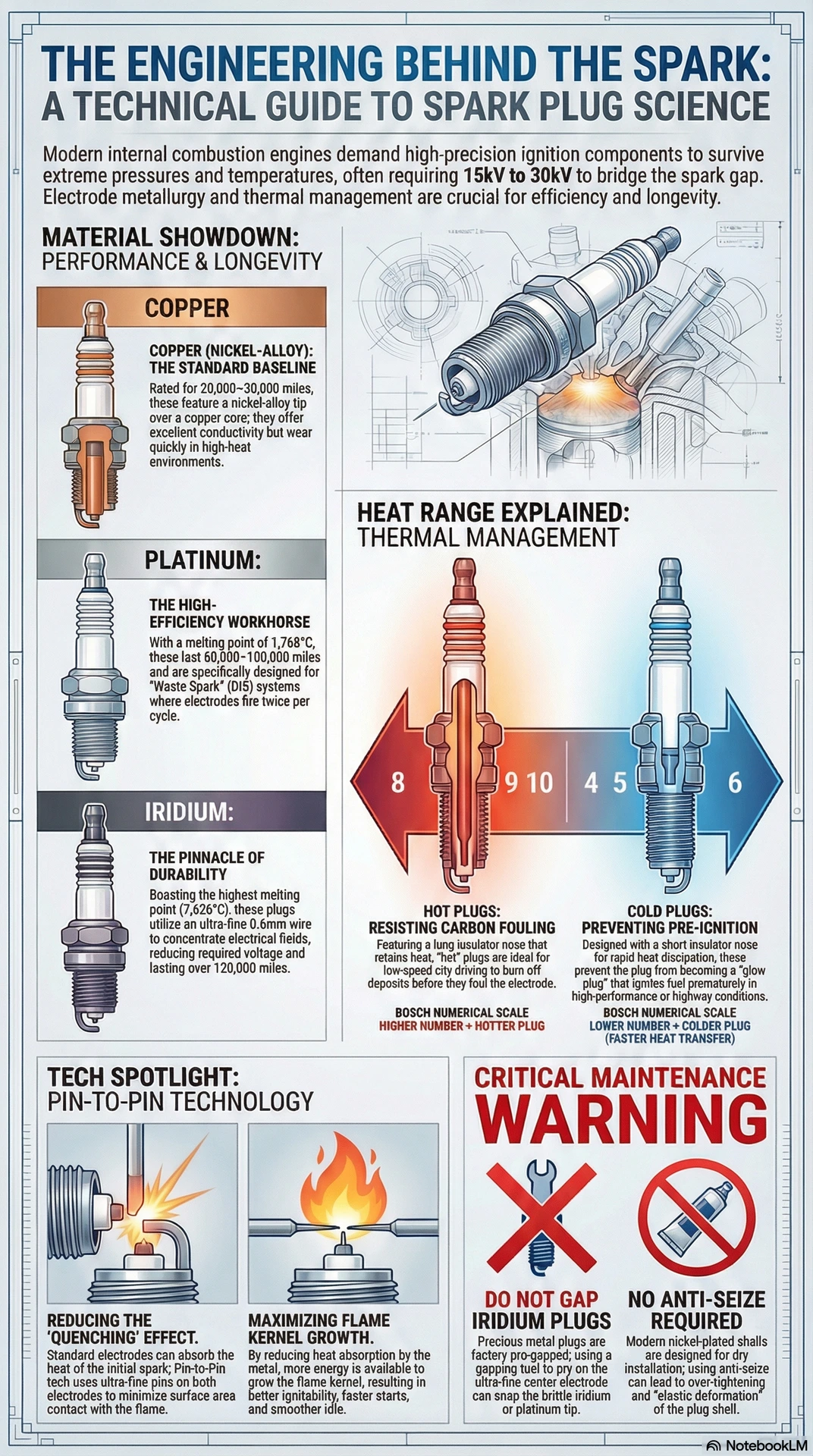
- The Metallurgy: In standard "Copper" plugs, the copper core is covered by a nickel-alloy jacket. Pure copper is too soft and has a melting point of only 1,085°C, which is too low to survive direct exposure to the spark arc.
- Performance Profile: Nickel-alloy plugs offer excellent conductivity and are very affordable. They are often the best choice for older, low-voltage distributor-based ignition systems found in pre-2000s vehicles.
- The Downside: Nickel is susceptible to spark erosion. Every time the plug fires, a microscopic amount of metal is vaporized. Consequently, standard copper/nickel plugs have a short lifespan, typically requiring replacement every 20,000 to 30,000 miles.
- Bosch Innovation: To combat the rapid wear of standard nickel, Bosch introduced Yttrium-enhanced copper core plugs. Yttrium, a rare earth element used in superconductors, is added to the nickel alloy to increase resistance to oxidation and spark erosion, effectively extending the service life beyond that of a standard copper plug.
The Endurance Upgrade: Platinum Technology
As emission regulations tightened and engines became harder to service (often requiring the removal of intake manifolds), manufacturers sought plugs that could last longer. Enter Platinum.
- The Physics: Platinum is a dense precious metal with a melting point of 1,768°C. It is significantly harder than nickel, allowing for much slower erosion rates.
- Single Platinum: These plugs feature a fine platinum disc laser-welded to the center electrode. This design focuses the spark and reduces wear, extending the service life to approximately 60,000 miles.
Double Platinum and the "Waste Spark" System: This is a critical distinction for DIY mechanics. Many vehicles from the late 1990s and 2000s use a "Waste Spark" ignition system, where one coil fires two spark plugs simultaneously. One plug fires on the compression stroke (igniting fuel), and the partner plug fires on the exhaust stroke (wasting the spark). Crucially, the "wasted" spark travels in reverse polarity (from the ground electrode to the center electrode).
- If you install a Single Platinum plug in a waste spark system, the reverse spark will eat away the non-platinum ground electrode in half the expected time.
- Double Platinum plugs feature precious metal buttons on both the center and ground electrodes, making them essential for these specific ignition systems to ensure a lifespan of up to 100,000 miles.
The High-Performance Standard: Iridium
Iridium is the "crown jewel" of modern spark plug materials. It is six times harder and eight times stronger than platinum, with an incredible melting point of 2,426°C (approx. 4,400°F).
- The Fine-Wire Advantage: Because iridium is so hard, manufacturers can machine the center electrode into an ultra-fine wire, often as thin as 0.4mm to 0.6mm.
- Electrical Field Concentration: Physics dictates that electrical potential concentrates around sharp points. By narrowing the electrode to a fine wire, the electrical field strength increases, allowing the spark to jump the gap at a lower voltage. This reduces the load on ignition coils and ensures a spark even under the extreme cylinder pressures of modern turbocharged and Gasoline Direct Injection (GDI) engines.
- Durability: Iridium plugs are chemically stable and highly resistant to oxidation. They are the standard for almost all new vehicles, with service intervals often exceeding 120,000 miles.
- Pin-to-Pin Technology: To further improve efficiency, Bosch utilizes "Pin-to-Pin" designs (Double Iridium). This involves placing a fine wire on both the center and ground electrodes. This setup minimizes "quenching"—a phenomenon where the cold metal electrodes absorb the heat of the spark kernel, extinguishing the flame before it spreads. By reducing the metal surface area touching the spark, Pin-to-Pin plugs allow the flame to expand faster, improving fuel efficiency and idle smoothness.
Thermal Engineering: Decoding Heat Range
One of the most misunderstood concepts in ignition engineering is the "Heat Range." A spark plug does not create heat; it removes it. The heat range is a measure of the plug's ability to transfer thermal energy from the firing tip into the cylinder head and cooling system.
The Goldilocks Zone: The firing tip must maintain a temperature between 500°C and 850°C.
- Below 500°C: The plug is too cool to burn off carbon deposits. This leads to "Carbon Fouling," where soot bridges the electrodes and causes misfires.
- Above 850°C: The ceramic insulator can blister, and the electrodes may melt. Worse, the glowing hot tip can ignite the fuel before the spark fires (Pre-Ignition), which can destroy pistons and valves.
Hot vs. Cold Plugs:
- Hot Plugs: Have a long insulator nose. This creates a longer path for heat to travel before it reaches the metal shell, causing the tip to stay hotter. These are ideal for standard passenger cars, city driving, and low-compression engines.
- Cold Plugs: Have a short insulator nose. Heat dissipates rapidly into the cylinder head. These are required for high-performance, turbocharged, or nitrous-injected engines to prevent overheating.
Brand Confusion: Mechanics must be wary of numbering scales.
- NGK: Lower numbers are HOT, Higher numbers are COLD.
- Bosch: Higher numbers are HOT (e.g., a Bosch 8 is hotter than a Bosch 5). Using the wrong number can be fatal to an engine.
The Multi-Electrode Debate: Super 4 and Surface Gaps
You may encounter plugs with two, three, or four ground electrodes, such as the Bosch Super 4. Contrary to popular belief, these plugs do not create four sparks simultaneously. Electricity always follows the path of least resistance.
- The Principle: The spark jumps to the ground electrode with the best conductivity at that microsecond. As one edge wears down and resistance increases, the spark naturally jumps to a different electrode.
- Surface Air-Gap: These multi-ground plugs often utilize "surface air-gap" technology, where the spark glides across the face of the insulator nose before jumping to the ground. This scrubbing action burns off carbon deposits, making these plugs excellent for older engines that may run rich or consume oil.
- Limitations: While durable, multi-ground plugs can shroud the spark kernel, slightly inhibiting flame propagation in modern high-swirl combustion chambers. They are rarely recommended for modern coil-on-plug systems unless specified by the OEM.
Summary of Spark Plug Materials
| Material | Electrode Design | Typical Lifespan | Conductivity | Melting Point | Ideal Application |
|---|---|---|---|---|---|
| Copper (Nickel Alloy) | 2.5mm Nickel Tip | 20k - 30k miles | Excellent | ~1,453°C (Nickel) | Older V8s, Distributors, Low Voltage |
| Platinum | 1.1mm Platinum Disc | 40k - 60k miles | Good | 1,768°C | Mid-2000s Sedans, coil-on-plug |
| Double Platinum | Platinum on both tips | 60k - 100k miles | Good | 1,768°C | Waste Spark Ignition Systems (DIS) |
| Iridium | 0.4mm - 0.6mm Wire | 100k - 120k+ miles | Moderate | 2,426°C | GDI, Turbocharged, Modern OEM |
| Silver | Solid Silver | Varies | Highest | 961°C | Racing, LPG/CNG, Old Euro Sports Cars |
Q&A: Engineering & Selection
Q: Can I upgrade from a Copper plug to an Iridium plug? A: Yes, and it is highly recommended. Upgrading to Iridium will lower the strain on your ignition coils and provide consistent performance for much longer. However, you should never downgrade from Iridium to Copper. A modern engine designed for Iridium will chew through a copper plug in as little as 10,000 miles due to the high-energy ignition environment.
Q: Why are Iridium plugs so expensive? A: Iridium is a rare precious metal, much scarcer than gold or platinum. Additionally, the manufacturing process requires advanced laser welding techniques to attach the microscopic iridium wire to the electrode body without it breaking off under thermal stress. You are paying for the materials and the precision engineering that allows for 100,000-mile intervals.
Q: Does "gapping" apply to Iridium plugs? A: Most Bosch Iridium plugs come "pre-gapped" and packaged with a protective sleeve to preserve that gap. You should generally avoid gapping them. The center wire is so thin (0.4mm) that prying it with a traditional coin-style gapping tool can easily snap the wire or damage the laser weld. If you must adjust it, use a specialized wire-style tool and only move the ground electrode, never touching the center tip.
Q: What is "Quenching" and why is it bad? A: Quenching happens when the spark plug electrodes absorb the heat from the initial spark kernel, cooling it down before it can fully ignite the fuel mixture. This leads to incomplete combustion or misfires. Fine-wire Iridium plugs and "Pin-to-Pin" designs minimize the surface area of the metal, reducing quenching and allowing the flame to grow faster and hotter.