
If you drive a modern turbocharged vehicle, you are enjoying a marvel of engineering that forces dense, oxygen-rich air into your engine to generate impressive power without sacrificing fuel economy. However, this performance comes with an incredible amount of heat and friction. Because the internal shaft of a turbocharger can spin at speeds exceeding 150,000 RPM, it requires a constant, pressurized supply of engine oil to lubricate its bearings and keep it cool.
To keep this vital oil inside the center housing and out of your engine's intake and exhaust systems, turbochargers utilize specialized internal seals. When drivers see blue smoke pouring from their tailpipe or find oil pooled in their intake tubes, the immediate assumption is often, "My turbo seals are blown!"
However, automotive experts know that perfectly functioning turbochargers are frequently—and wrongly—blamed for oil leaks. In reality, a "leaking seal" is almost always a symptom of a larger underlying issue with the engine or installation, rather than a failure of the seal itself. Before you spend thousands of dollars replacing your turbocharger, it is critical to understand how these seals work, how to spot the genuine signs of leakage, and how to diagnose the actual root cause of the problem.
The Misconception: How Turbocharger Seals Actually Work
When most people hear the word "seal," they picture a pliable rubber O-ring or a rubber lip-type contact seal. Turbochargers do not use rubber seals. Due to the extreme rotational speeds, immense shaft clearances, and housing temperatures that can exceed 450°F (and exhaust gases reaching up to 1,742°F), rubber would instantly melt and disintegrate.
Instead, turbochargers utilize "split-rings," which look and function almost exactly like the piston rings inside your engine's cylinders. These metal rings sit stationary inside a precision-machined bore, while the turbo shaft spins within them.
Because they are split-rings with necessary running clearances, they do not seal 100 percent mechanically. Instead, they rely on a dynamic pressure system to keep oil contained. There are three pressure zones in a turbo: the compressor housing, the turbine housing, and the Center Housing Rotating Assembly (CHRA) where the oil resides. The compressor and turbine wheels are aerodynamically designed to build up air pressure behind them. As long as the air pressure in the compressor and turbine housings is greater than the oil pressure inside the CHRA, the oil is pushed back inside and cannot leak out.
Therefore, if oil is leaking past your seals, it almost always means the pressure balance has been destroyed by an outside force.
Top Signs Your Turbo Seals Are Leaking
Regardless of the root cause, if the pressure balance is compromised, oil will escape the center housing. Here are the primary symptoms that your turbo seals are allowing oil to bypass them.
1. Blue Exhaust Smoke
The most notorious and visible sign of an oil leak in your turbocharger system is blue or thick grey smoke billowing from your exhaust tailpipe.
If oil leaks past the turbine-side seal (the hot side), it drips directly into the blistering hot exhaust stream and instantly burns off, creating thick smoke.
If oil leaks past the compressor-side seal (the cold side), it gets blown through your intercooler and directly into the engine's combustion chambers, where it is burned along with your air/fuel mixture.
2. High Oil Consumption
If your dashboard low-oil light is constantly illuminating, or you find yourself needing to top off your engine oil every few hundred miles without any visible oil puddles under the car, your turbocharger could be quietly burning it. Check your spark plugs; if they are coated in oily residue, oil is entering the combustion chamber, likely via a leaking compressor seal.
3. Oil Pooling in the Intake Track
It is normal to have a very light, microscopic film of oil vapor inside your intake tubes due to the engine's crankcase ventilation system. However, if you unbolt your compressor inlet or charge air pipes and find heavy oil pooling or dripping, oil is aggressively escaping through the compressor sealing ring.
4. Carbon Sludge and Coking
If oil leaks past the turbine seal and sits in the exhaust housing when you shut the engine off, the extreme heat will cause that stationary oil to "coke" or bake into hard carbon deposits. Over time, this sludge builds up, unbalancing the turbine wheel and leading to a complete mechanical failure of the turbocharger bearings.
Diagnosing the Root Cause: Why Are the Seals Leaking?
If you have confirmed that oil is leaking past your turbo seals, do not immediately buy a new turbocharger. Because you cannot simply service or replace a turbo seal like a standard rubber O-ring, replacing the turbo without fixing the root cause will simply cause the brand-new turbo to leak as well. You must use a strategy-based diagnostic approach. Check the following external issues first:
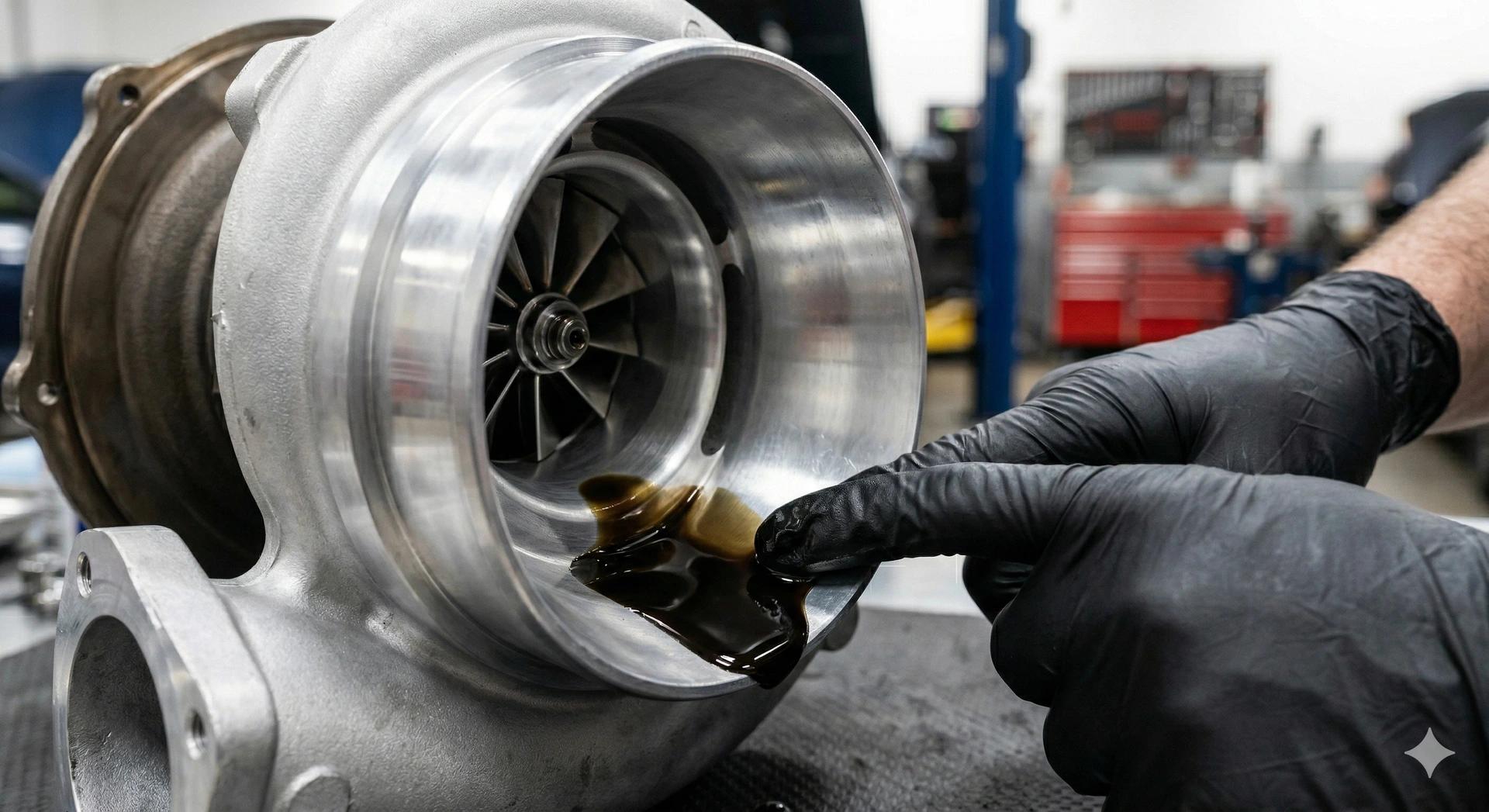
1. Restricted Oil Drain Line: Oil is pumped into the top of the turbo under high pressure, but it relies entirely on gravity to drain out of the bottom and back into the engine oil pan. If the drain line is kinked, dented, or clogged with excessive silicone sealant, the oil cannot escape. The CHRA rapidly fills with oil, the pressure skyrockets, and the oil is violently forced out past both the compressor and turbine split-rings. Always inspect the drain line first.
2. Blocked PCV System (Crankcase Breather): Your engine's Positive Crankcase Ventilation (PCV) system relieves pressure from the engine block. If the crankcase breather becomes clogged, positive pressure builds up inside the engine oil pan. This pressure travels right up the turbo oil drain line, effectively pushing the oil back into the turbocharger and forcing it out the seals.
3. Restricted Air Intake (Dirty Air Filter): If your air filter is heavily clogged with dirt and debris, the spinning compressor wheel struggles to pull in air. This creates a massive vacuum (negative pressure) inside the compressor housing. This vacuum literally sucks the oil straight out of the CHRA, past the split-ring seal, and into the intake manifold.
4. Excessive Idling and Poor Driving Habits: Extended periods of engine idling can actually cause oil to burn. Idling creates a vacuum on the turbine side, and because shaft speeds and housing pressures are low, oil can easily seep through the turbine-side sealing ring. Additionally, shutting the engine down hot without a brief cool-down period destroys the oil around the sealing rings, leading to bearing failure.
By checking your drain lines, replacing your air filters, and ensuring your crankcase is breathing properly, you can often "cure" failing turbo seals without ever having to unbolt the turbocharger from the exhaust manifold.
Summary Inspection Checklist
Checked Component | Diagnostic Action | Symptoms of Failure / Leakage |
Exhaust Tailpipe | Observe exhaust under acceleration/deceleration. | Blue smoke indicating oil burning in the exhaust or combustion chamber. |
Intake / Charge Pipes | Remove piping and inspect visually. | Heavy oil pooling indicates a compressor-side seal leak. |
Oil Drain Line | Check for kinks, correct sizing, and RTV blockages. | Oil backs up into the CHRA, forcing fluid past both turbine and compressor seals. |
PCV / Crankcase Breather | Ensure the breather is clear and functioning. | Crankcase pressure prevents oil drainage, pushing oil past the seals. |
Air Filter | Inspect for dirt, debris, or blockages. | A clogged filter creates a vacuum that sucks oil past the compressor seal. |
Spark Plugs | Remove and inspect for fouling. | Oily residue indicates oil entering the combustion chamber via the compressor. |
Can Turbocharger Seals Be Replaced, and What Does It Cost?
A common question drivers ask after spotting oil in their intake or blue smoke from the tailpipe is: "Can I just swap out the leaking seal?"
The short answer is no—you cannot simply replace a turbocharger seal on its own.
Because turbo seals are metallic split-rings precision-fitted to the spinning shaft, replacing them requires completely disassembling the turbocharger. Furthermore, whenever a turbo is taken apart, the rotating assembly must be precision dynamic balanced at speeds exceeding 100,000+ RPM upon reassembly. Replacing a seal without professional high-speed balancing will cause immediate shaft vibration, destroying the new seals and bearings within miles.
When facing genuine seal wear, you have three primary repair routes depending on your budget and the turbo's overall condition:
1. Rebuild / Repair Options & Part Costs
| Option | What It Involves | Typical Part Cost | Best For |
| Professional Turbo Rebuild | Disassembly, thorough cleaning, replacing all internal seals/bearings, and high-speed balancing. | $300 – $800 (bench service) | Stock turbos with sound housings and minimal shaft/wheel damage. |
| CHRA / Cartridge Replacement | Replacing the entire center core (CHRA) containing pre-assembled, factory-balanced shafts, seals, and bearings while retaining outer housings. | $200 – $600 | A cost-effective balance between a full replacement and bench rebuilding. |
| Complete Turbocharger Replacement | Bolt-in replacement of the entire turbo assembly (OEM or performance upgrade). | $800 – $2,500+ | Heavily damaged, cracked, or obsolete units where rebuilding isn't viable. |
2. Labor & Installation Costs
In addition to parts or rebuilding fees, you must account for shop labor to remove and reinstall (R&R) the turbocharger:
Labor Time: Most vehicles require 3 to 6 hours of labor depending on engine bay clearance and piping complexity.
Labor Rates: Standard shop rates range from $100 to $200+ per hour, translating to roughly $400 – $1,200 in labor alone.
Associated Supplies: You should always budget an extra $100 – $250 for fresh engine oil, an oil filter, new coolant, and mandatory oil feed/drain line gaskets or replacement lines.
Total Expected Out-of-Pocket Cost:
Expect to pay between $800 and $1,500 for a pre-balanced CHRA core replacement or professional rebuild with installation, or $1,500 to $3,500+ for a complete brand-new OEM turbo replacement at a repair shop.
Summary Takeaway
Before committing to a multi-hundred or multi-thousand-dollar repair, always resolve external pressure issues first. Clearing a clogged PCV system or replacing a dirty air filter costs under $50 and often fixes the "seal leak" entirely without touching the turbo. If the seals are genuinely worn from shaft play or debris, replacing the CHRA cartridge or opting for a bench rebuild offers the best value compared to buying a complete new assembly.
Frequently Asked Questions (Q&A)
Can I just replace the seals in my turbocharger? No. Unlike a rubber gasket on a water pump, turbocharger seals are precision-machined metallic split-rings. You cannot simply pop the turbo open and swap an O-ring. If the seals are genuinely worn due to abrasive oil contamination or shaft play, the entire turbocharger center cartridge (CHRA) must be professionally rebuilt and balanced, or completely replaced.
Why does my turbo only blow blue smoke when I idle for a long time? Extended engine idling creates a vacuum on the turbine side of the turbocharger. Because the engine RPMs are low, the exhaust gas pressure required to help the split-rings seal is missing. This vacuum pulls oil past the turbine seal and into the hot exhaust housing, causing it to smoke.
I just installed a brand new turbo, and it's already leaking oil from the seals. Is the turbo defective? It is highly unlikely. Only a very small fraction of turbochargers fail out of the box due to manufacturing defects. A brand new turbo leaking oil is almost always caused by an installation error—such as using too much silicone sealant that clogs the oil drain line, or a pre-existing engine problem like excessive crankcase pressure (a blocked PCV valve).
Can a dirty air filter really cause a turbo oil leak? Yes. The compressor wheel spins incredibly fast to draw in air. If the air filter is blocked, the compressor wheel creates a strong vacuum inside the housing as it starves for air. This vacuum overcomes the dynamic pressure of the internal split-ring seals and sucks oil out of the center bearing housing and into the engine.