
3-Point Diagnostic Table
Dry Carbon Fouling: | (Black/Sooty) - Sign of rich fuel mixture or short trips. |
Oil Fouling: | (Wet/Oily) - Sign of worn valve guides or piston rings. |
Perfect Burn: | (Tan/Grey) - Sign of a healthy engine. |
Every car owner in Egypt knows that sudden, sinking feeling when the "Check Engine" light flashes to life on the dashboard. It’s a moment of dread, a vague warning that could mean anything from a loose gas cap to a catastrophic failure. But what if your engine had a simpler, more direct way of telling you what’s wrong? What if it could give you a detailed report card before the warning light even comes on?
It does. That report card is your spark plug.
Most drivers see the spark plug as a simple ignition source. In reality, it’s a sophisticated diagnostic tool. Sitting inside the combustion chamber, it’s the only part of your engine that gives you a direct, visible record of what’s happening with your air-fuel mixture, your oil, and your engine’s internal health.
For car owners in Egypt, this knowledge is not just a hobby—it's a necessity. Our unique driving conditions, from the stop-and-go crawl of Cairo traffic to the demanding heat of a long-distance drive, combined with variations in fuel quality, put immense stress on our engines. Proactive maintenance is the key to longevity. This guide will transform you from a car owner who guesses into one who knows. We'll teach you how to read your engine’s secret language, so you can pinpoint problems early and choose the exact, high-quality replacement part you need from GE for Trading (جى اى للتوريدات).
The Baseline: What a "Perfect" Spark Plug Looks Like
Before you can diagnose a problem, you must know what "normal" looks like. A healthy, happy spark plug tells a story of complete, efficient combustion.
When you remove a plug from a well-running engine, you should see a light tan or grayish-white color on the insulator nose (the white ceramic tip). It should be clean and dry, with no significant buildup.
This color is the gold standard. It indicates that the spark plug is operating within its ideal Self-Cleaning Temperature Range, typically between 450°C and 870°C. In this range, the plug gets hot enough to burn off any carbon or fuel deposits from the engine's combustion process but not so hot that it begins to melt or cause damage.
This is your baseline. Any deviation from this light tan, dry appearance—be it black soot, wet oil, or white blisters—is a critical clue. It signals a fault in your fuel, air, ignition, or a deeper mechanical issue.
The Spark Plug Reading Chart: 6 Critical Diagnostic Scenarios
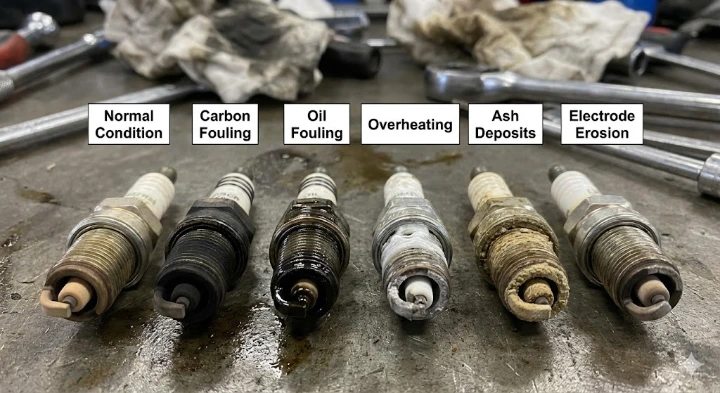
This is the core of our engine health check. Grab your plug, compare it to the descriptions below, and find your engine's story. We've arranged this like a visual spark plug reading chart to make your engine diagnostic simple.
For an expert comparison, you can also reference Bosch's official diagnostic chart to see these conditions in high-resolution.
1. Carbon Fouling: The Black, Sooty Warning (Too Rich)
- Description: The insulator nose and electrodes are covered in a dry, velvety, black soot. It looks like the inside of a kerosene lamp.
- Root Cause: The air-fuel mixture is "too rich" (too much fuel, not enough air). The plug isn't getting hot enough to burn off the excess, and the soot is smothering the spark.
Common Causes:
- A clogged or blocked air filter.
- A faulty oxygen (O2) sensor or Mass Air Flow (MAF) sensor.
- A stuck-open thermostat or prolonged idling.
- Leaking or malfunctioning fuel injectors.
- Impact: This is a primary cause of engine misfire diagnosis. You'll experience difficult cold starts, sluggish acceleration, rough idling, and a significant drop in fuel economy—a costly problem with today's fuel prices.
- Solution: You must replace the spark plugs, as they are too fouled to be reliably cleaned. But do not just replace the plugs. You must fix the root cause first, or the new plugs will foul in a matter of days. The most common and easiest fix is to check and replace your air filter.
- Link: Solve the #1 cause of carbon fouling. Shop our complete Air Filter Product Category.
2. Oil Fouling: The Wet, Oily Disaster (Engine Wear)
- Description: The plug tip is coated in a wet, slick, black oily deposit. It will be shiny and greasy to the touch.
- Root Cause: This is a more serious mechanical problem. Engine oil is leaking into the combustion chamber and burning on the plug.
Common Causes:
- Worn-out piston rings (the most common cause in high-mileage engines).
- Worn valve guides or valve stem seals.
- A failing PCV (Positive Crankcase Ventilation) valve.
- Impact: Obvious blue-white smoke from the exhaust, especially on startup or under acceleration. The engine will consume oil rapidly, and the plug will constantly misfire.
- Solution: Replacing the spark plug is a temporary patch. It will foul again very quickly. This engine requires inspection by a qualified mechanic to address the internal oil leak. However, preventing this is key. Using a premium oil with strong detergents and seal conditioners is your best defense against premature wear.
- Monitor your oil level and defend your engine's internals. Browse our collection of High-Quality Engine Oil to prevent wear.
3. Overheating: The Bleached, Blistered Threat (Too Hot)
- Description: The insulator is stark white, gray, or chalky. In severe cases, it will look glazed or melted, and the electrodes will be visibly eroded, pitted, or even missing.
- Root Cause: The spark plug is running dangerously hot, far above its self-cleaning range. This is a sign of pre-ignition (the fuel igniting before the spark) or detonation.
Common Causes:
- Incorrect Plug: The plug's "heat range" is too hot for the engine (a common mistake).
- Lean Mixture: The air-fuel mixture is "too lean" (too much air, not enough fuel).
- Overly advanced ignition timing.
- Severe engine cooling problems (low coolant, bad water pump).
- Impact: This is extremely dangerous for your engine. Overheating can burn valves, score cylinder walls, and even melt holes directly through the top of your pistons, leading to complete engine destruction.
- Solution: Stop driving the car hard immediately. The root cause must be identified. If the issue is the plug itself, you must replace it with a colder heat range plug to better dissipate heat.
- Link: Don't risk engine-destroying heat. Learn about your engine's correct heat range here.
4. Ash Deposits: The Crusty, Tan Residue (Additives)
- Description: You'll see hard, crusty deposits on the insulator and electrodes. The color is often tan, yellow, or reddish-brown, resembling cinders.
- Root Cause: These are non-combustible materials building up. They are almost always from additives in the fuel or, more commonly, from the detergents and anti-wear agents in engine oil.
Common Causes:
- Using lower-quality fuel with heavy additives.
- Using lower-quality engine oil with high ash content.
- An internal coolant leak (will leave a greenish-white deposit).
- Impact: At low levels, it's often harmless. But as the deposits build, they can become electrically conductive, shorting out the plug. Worse, they can "glow" red-hot and act as an ignition source, triggering pre-ignition.
- Solution: Replace the spark plugs. The best long-term solution is to switch to high-quality fuel and lubricants that are formulated to burn cleanly and leave minimal deposits.
- Link: Your engine is what it eats. Upgrade to our Premium Lubricants Product Page to protect your engine and plugs.
5. Electrode Erosion: The "Good" Failure (Normal Wear)
- Description: The plug looks mostly normal (light tan), but the electrodes are the problem. The center and/or ground electrodes are severely rounded, worn down, and the gap between them is visibly wide.
- Root Cause: Simple, normal, long-term wear. Every spark (millions of them!) erodes a microscopic amount of metal. After 80,000-160,000 km (on modern iridium or platinum plugs), this erosion widens the gap.
- Impact: The wider gap requires more voltage from the ignition coil to create a spark. This leads to hard starting (especially in cold weather), hesitation under acceleration, and reduced fuel economy.
- Solution: This is the best-case scenario! Your engine is healthy; it just needs a routine replacement. This is the perfect time to upgrade from standard copper to platinum or iridium plugs for a much longer service life and a stronger, more consistent spark.
- Link: You found the problem. Time for an easy replacement! See Why Upgrading to Platinum or Iridium Spark Plugs is a Smart Choice.
6. Mechanical Damage: The Catastrophic Failure
- Description: The spark plug is physically broken. The ceramic insulator is cracked, chipped, or shattered, or the ground electrode is bent, broken, or smashed flat.
Root Cause: This is almost always caused by one of two things:
- Improper Installation: The plug was dropped before installation, the wrong tool was used, or it was over-torqued, cracking the ceramic.
- Foreign Object: A piece of a broken valve, a chip of carbon, or some other object was inside the combustion chamber and was smashed by the piston.
- Impact: Immediate and total misfire in that cylinder. If a foreign object was the cause, your engine likely has severe internal damage.
- Solution: Stop the engine immediately. The cylinder must be inspected with a borescope by a professional. This highlights the absolute necessity of correct installation procedures.
- Link: Avoid this costly mistake. Learn the correct procedure with A Step-by-Step Guide to Installing Bosch Spark Plugs.
The GE Trading Advantage: From Diagnosis to Solution
Now you have the knowledge. You’ve used this spark plug reading chart to become an informed car owner. You haven't just guessed; you've completed an engine health check right in your own garage.
But what's next?
Diagnosing the problem is only half the battle. The solution is using the right, high-quality part. Buying a cheap, unverified spark plug is like putting a bandage on a wound without cleaning it first. It won't last, and it won't fix the underlying issue.
This is where GE for Trading comes in. We are not just a parts seller; we are your maintenance partner. We have built our inventory around the specific needs of drivers in Egypt, stocking only genuine, world-class brands like Bosch, NGK, and Torch. We have the exact plugs and filters specified for the most common cars on our roads, from Nissan and Renault to Hyundai and Kia.
Don't just diagnose the problem—solve it with the right part. Shop our complete collection, backed by our expertise, and get your engine running perfectly again.
Quick Diagnostic Summary Table
| Spark Plug Appearance | Diagnostic | Potential Root Cause | Recommended Action |
| Light Tan / Grayish-White | Normal | Healthy engine combustion. | No action needed; replace at service interval. |
| Dry, Sooty Black | Carbon Fouled | Rich air-fuel mixture; clogged air filter. | Replace filter and check fuel injectors. |
| Wet, Shiny Black | Oil Fouled | Leaking piston rings or valve seals. | Professional engine inspection; check oil type. |
| Chalky White / Blistered | Overheated | Wrong heat range; lean mixture; cooling issue. | Stop driving immediately; verify plug heat range. |
| Tan/Reddish Crusty Gunk | Ash Deposits | Low-quality fuel or oil additives. | Replace plugs and switch to premium lubricants. |
| Rounded/Worn Electrodes | Normal Wear | Reached the end of its service life. | Upgrade to Platinum or Iridium plugs. |
| Cracked or Smashed | Mechanical Damage | Improper installation or engine internal failure. | Stop engine; inspect cylinder with a borescope. |
Engine Health & Spark Plug Diagnostics: Frequently Asked Questions
Q1: What does a worn spark plug electrode look like? A: A worn spark plug electrode typically shows a rounded center electrode or a thinned-out ground electrode. You may also notice an increased "gap" between the two. In severe cases, the electrode might be partially melted or covered in heavy carbon deposits (black soot) or oil, indicating that the plug is no longer firing efficiently.
Q2: How can I tell if my engine is running too "lean" or "rich" by looking at the plugs? A: Look at the insulator tip (the white porcelain part). If it is stark white or blistered, your engine is running "lean" (too much air, not enough fuel). If it is covered in dry, black soot, it is running "rich" (too much fuel, not enough air). A healthy plug should have a light tan or gray color.
Q3: Does a "wet" spark plug always mean an oil leak? A: Not necessarily. A wet, black appearance usually indicates oil fouling, which could mean worn valve guides or piston rings. However, if the plug smells like gasoline, it may simply be fuel-fouled, meaning the engine is flooded or there is a localized ignition failure (like a bad coil pack) preventing the fuel from burning.
Q4: Can I clean a worn spark plug electrode to make it last longer? A: While you can clean carbon deposits with a wire brush or specialized cleaner for a temporary fix, you cannot "fix" a worn electrode. Once the metal has eroded and the gap has widened, the electrical resistance increases, putting strain on your ignition coils. It is always safer and more fuel-efficient to replace the plugs.
Q5: How often should I check my spark plugs for wear? A: For standard copper plugs, check every 30,000 km. For high-performance Iridium or Platinum plugs, they can last up to 100,000 km, but we recommend a visual inspection every 50,000 km to catch engine health issues early before they cause a breakdown.
Browse the full GE Trading Spark Plugs Category Page and buy your replacement plugs online now.
For a complete deep dive into choosing, diagnosing, and maintaining your entire ignition system, check out our ultimate Master Spark Plugs Guide.