
The Nissan Rogue and the Aging American Fleet
The Nissan Rogue has long been a staple of the American suburban landscape. As a practical, comfortable, and affordable crossover, it consistently dominates the sales charts. In 2025 alone, the Nissan Rogue ranked as the 14th best-selling vehicle in the United States, moving an impressive 217,896 units.
However, the broader economic context of vehicle ownership in America is shifting rapidly. The average age of light vehicles in the US has climbed to a record 12.8 years in 2025. This represents the second consecutive year of a two-month increase in the average age, signaling a fundamental transition where vehicle durability and repairability are prioritized over frequent replacement. Consumers are holding onto their vehicles longer, driven by elevated new vehicle prices and high interest rates.
As millions of Nissan Rogues enter the aftermarket "sweet spot"—the period between six and fourteen years of age where major mechanical components require replacement—owners are facing a critical maintenance juncture. While the Rogue is a highly popular and versatile vehicle, its long-term reputation is inextricably linked to one specific component: its Continuously Variable Transmission (CVT). In fact, the health and maintenance of the CVT is the single most searched topic for Rogue owners today.
This comprehensive survival guide breaks down the notorious CVT issues plaguing the Nissan Rogue and provides the exact aftermarket solutions—from external transmission oil coolers to heavy-duty liftgate struts—needed to keep your crossover safely on the road.
Understanding the Nissan Rogue CVT Flaw
Unlike a traditional automatic transmission that uses a complex series of fixed gears, a Continuously Variable Transmission (CVT) uses a system of pulleys and a heavy-duty steel belt to provide an infinite number of gear ratios. In theory, this design maximizes fuel economy and keeps the engine in its optimal power band. In practice, however, early and mid-generation Nissan Rogues have experienced severe reliability issues under real-world driving conditions.
The primary enemy of any CVT is heat. When the transmission fluid breaks down due to excessive thermal loads, the steel belt begins to slip against the pulleys, generating metal shavings and leading to catastrophic internal failure.
The Three Warning Signs of Rogue CVT Failure
Consumer discourse and diagnostic data highlight three pervasive symptoms that Rogue owners must watch out for:
CVT Shudder: Often felt during low-speed acceleration, a CVT shudder feels like the vehicle is driving over rumble strips. This aggressive vibration is a direct result of the transmission belt slipping and struggling to grip the pulley faces.
Whining Noises at Highway Speeds: If your Rogue sounds like a jet engine taking off when you merge onto the highway, your CVT is crying for help. This high-pitched whine indicates that the transmission fluid has overheated, lost its viscosity, and is no longer properly lubricating the internal bearings.
Sudden Loss of Acceleration: This is the most dangerous and widely discussed symptom. When the CVT reaches a critical temperature threshold, the vehicle's computer engages "limp mode" to protect the drivetrain. This results in a sudden, terrifying loss of acceleration, leaving drivers stranded on the shoulder of the highway.
The Ultimate Preventative Upgrade: External Transmission Oil Coolers
Because heat is the root cause of these failures, Rogue owners are actively seeking "transmission cooler" upgrades to prevent the overheating that causes these catastrophic breakdowns.
Factory Nissan Rogues are often equipped with a rudimentary cooling system that routes transmission fluid through the bottom of the engine's radiator. While this is sufficient for light, low-speed commuting in mild climates, it completely fails to manage the thermal load during long highway road trips, mountain driving, or towing.
The Aftermarket Solution: The most effective way to save a Rogue's CVT is to install an External Transmission Oil Cooler. These aftermarket units act like a miniature secondary radiator dedicated entirely to your transmission fluid. Mounted behind the front grille, an external cooler utilizes the ambient air rushing into the front of the moving vehicle to drastically lower the temperature of the CVT fluid before returning it to the transmission housing.
By actively cooling the system, you prevent the fluid from degrading, stop the whining noises, and virtually eliminate the risk of a sudden loss of acceleration during a long summer road trip.
Fluid Matters: The Case for Valvoline CVT Fluid
A transmission cooler is only half of the survival equation; the fluid itself is the lifeblood of the CVT system. Nissan historically recommends their proprietary NS-2 or NS-3 fluids, but as these vehicles age into the aftermarket, strict adherence to high-quality synthetic alternatives is required to prevent shuddering.

Valvoline CVT Fluid has emerged as a prime aftermarket choice and a highly recommended upgrade for Rogue owners dealing with CVT overheating. Designed specifically for the unique friction requirements of a steel-belt-driven transmission, high-quality aftermarket fluids like Valvoline offer exceptional thermal stability and anti-wear properties.
The Golden Rule of CVT Maintenance: Do not wait for 100,000 miles to service your transmission. To avoid the infamous CVT shudder, you must treat your fluid as a wear item. Drain and fill procedures should be performed every 30,000 to 40,000 miles. When combining fresh Valvoline CVT Fluid with an external oil cooler, you are providing your Rogue with the ultimate defense against premature transmission death.
Beyond the Transmission: Other Common Nissan Rogue Issues
While the CVT dominates the conversation, the Nissan Rogue has a few other highly searched quirks and flaws that owners should be prepared to address as their vehicles cross the 100,000-mile milestone.
1. The 1.5L Turbo Engine: Fuel Odors and PCV Systems
If you own a newer generation Rogue (specifically the 2021-2024 model years), you may not have as many transmission worries, but there has been a significant uptick in "fuel odor" complaints.
Owners frequently report a strong smell of raw gasoline entering the cabin through the climate control system. This issue is heavily related to the 1.5L turbocharged engine, specifically regarding failures in the PCV (Positive Crankcase Ventilation) system and high-pressure fuel pump failures. If you smell gas inside your newer Rogue, do not ignore it—have the PCV system and fuel lines inspected immediately, as fuel vapors pose a significant safety and fire hazard.
2. Sagging Liftgates: The Need for Heavy-Duty Struts
On the exterior of the vehicle, "liftgate failure" is a pervasive issue for older Rogues. The factory gas struts that hold up the heavy rear hatch lose their pressurization over time, particularly in colder climates. This leads to the liftgate slowly sagging down and hitting owners on the head while loading groceries.
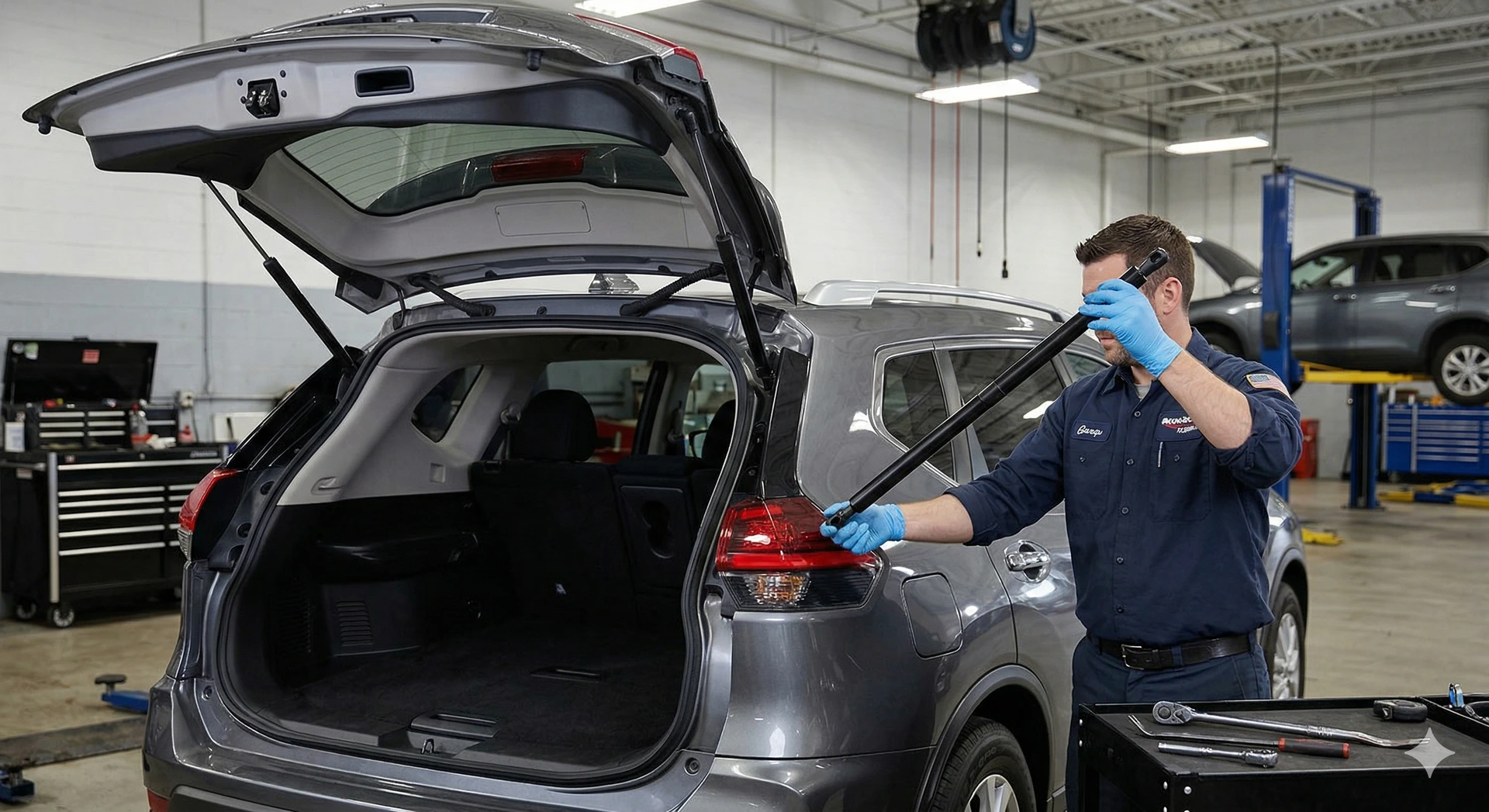
The fix is simple and highly accessible for DIY mechanics: upgrading to a set of aftermarket Heavy-Duty Liftgate Support Struts. These replacement struts cost a fraction of dealership prices, can be installed in your driveway with a single flathead screwdriver in under ten minutes, and provide a much stronger, more reliable lift for the life of the vehicle.
3. DIY Diagnostics: Reading the Codes
With the average vehicle age rising, relying on the dealership for every warning light is no longer economically viable. Because the Rogue's CVT failure is often preceded by hidden thermal warning codes that won't trigger an immediate Check Engine Light, having an advanced OBD2 scanner is critical.
A wireless scanner like the BlueDriver Pro is highly recommended for casual owners, as it offers a massive database of verified fixes directly to your smartphone. By scanning your Rogue periodically, you can catch transmission fluid pressure drops or overheating codes before the vehicle enters limp mode.
Nissan Rogue Essential Maintenance Summary
| Component / Upgrade | Primary Benefit | Recommended Action |
| Valvoline CVT Fluid | Superior thermal stability; prevents belt slipping and "shudder." | Drain and fill every 30,000 – 40,000 miles. |
| External Oil Cooler | Drastically lowers CVT temp; prevents "Limp Mode" on long trips. | Install behind front grille for maximum airflow. |
| Heavy-Duty Struts | Fixes sagging rear hatches; safer loading/unloading. | Replace DIY as soon as liftgate feels heavy or slow. |
| OBD2 Scanner | Detects hidden transmission "soft codes" before a breakdown. | Scan every oil change to monitor fluid temps. |
| PCV Valve (1.5L Turbo) | Eliminates raw fuel odors inside the cabin. | Inspect if you smell gas; replace to prevent vapor buildup. |
Frequently Asked Questions (Q&A)
1. Will using Valvoline CVT fluid void my Nissan warranty?
In the U.S., the Magnuson-Moss Warranty Act generally protects your right to use high-quality aftermarket fluids that meet or exceed OEM specifications. Valvoline CVT fluid is specifically engineered for these systems. However, if your Rogue is still under its initial factory powertrain warranty, many owners stick to Nissan NS-3 until the warranty expires before switching to high-performance aftermarket alternatives.
2. My Rogue is making a whining noise on the highway. Is it too late for a cooler?
Not necessarily! That high-pitched whine is often the sound of the fluid thinning out due to heat. Installing an external cooler and performing a fresh fluid exchange with Valvoline CVT synthetic can often "quiet" the transmission and prevent it from entering limp mode, potentially adding years to its lifespan.
3. Why does my 2021+ Rogue smell like gasoline inside?
This is a documented issue with the newer 1.5L Variable Compression (VC) Turbo engines. It is typically caused by a faulty PCV (Positive Crankcase Ventilation) system or a failing high-pressure fuel pump. If you smell gas, address it immediately, as it is a safety hazard and can lead to fuel dilution in your engine oil.
4. How do I know if my CVT is failing or just needs service?
"Soft" signs like a minor shudder or a highway whine usually point to fluid degradation that can be fixed with a service. However, if you see metal shavings in the fluid during a drain-and-fill, or if the vehicle frequently loses all power (Limp Mode), internal physical damage may have already occurred.
5. Can I install the external transmission cooler myself?
If you are comfortable removing the front bumper cover and splicing into rubber transmission lines, it is a straightforward DIY project. However, because a leak can lead to instant transmission failure, many owners prefer to have a professional shop handle the installation.
Conclusion: Keep Your Rogue Rolling
The Nissan Rogue remains an excellent, highly practical family vehicle. However, ignoring its maintenance needs—specifically regarding its sensitive transmission—is a recipe for a massive repair bill.
By taking proactive control of your vehicle's health, you can easily push your crossover well past the 150,000-mile mark. Upgrade your cooling capacity with an external transmission oil cooler, stick to a rigorous 30,000-mile service schedule using premium Valvoline CVT fluid, replace your failing liftgate struts, and utilize a smart OBD2 scanner to monitor your engine's vitals.
Recommended Amazon USA Products for Your Nissan Rogue
(Note: As specific Amazon ASINs frequently change, the secure links below will direct you to the exact search queries to find the current best, top-rated listings for these specific Nissan Rogue upgrades).
Valvoline Full Synthetic CVT Fluid (Essential for Smooth Shifting)
Universal External Transmission Oil Cooler Kits (Prevents CVT Overheating)
Heavy-Duty Liftgate Support Struts (Fixes a Sagging Rear Hatch)
BlueDriver Pro Bluetooth OBD2 Scanner (Best Wireless Scanner for Catching Hidden Codes)
Nissan Rogue PCV Valve Replacement (Addresses 1.5L Turbo Fuel Odors)